Ravi runs a hardware fittings manufacturing unit in Yamunanagar. Third-generation business. His grandfather started it in a small shed near the timber market. Today, they supply builders, distributors, and a few exporters across North India.
Good product. Fair pricing. Long-standing relationships. But last year, Ravi noticed something odd. A newer competitor, half his size, was showing up in conversations with buyers he had never even pitched to.
He asked one buyer how they found this competitor. The answer was simple. “I searched for hardware fitting manufacturers near Yamunanagar. Their website came up. Yours didn’t.”
Ravi had a website. It had been live for four years. It had his logo, a product gallery, and a phone number. That was it. No certifications, no case studies, no way to actually start a conversation without picking up the phone during business hours.
The competitor’s site had none of Ravi’s manufacturing history or reputation. But it had ten things Ravi’s site didn’t. And those ten things were enough to win the inquiry.
This is not a rare story. It plays out every week across Ambala, Yamunanagar, Panchkula, and every other industrial town in North Haryana. Good businesses lose winnable deals to weaker competitors who simply built a website that does more work. We’ve seen the same pattern play out for Ambala instrument manufacturers losing real money every year to this same gap.
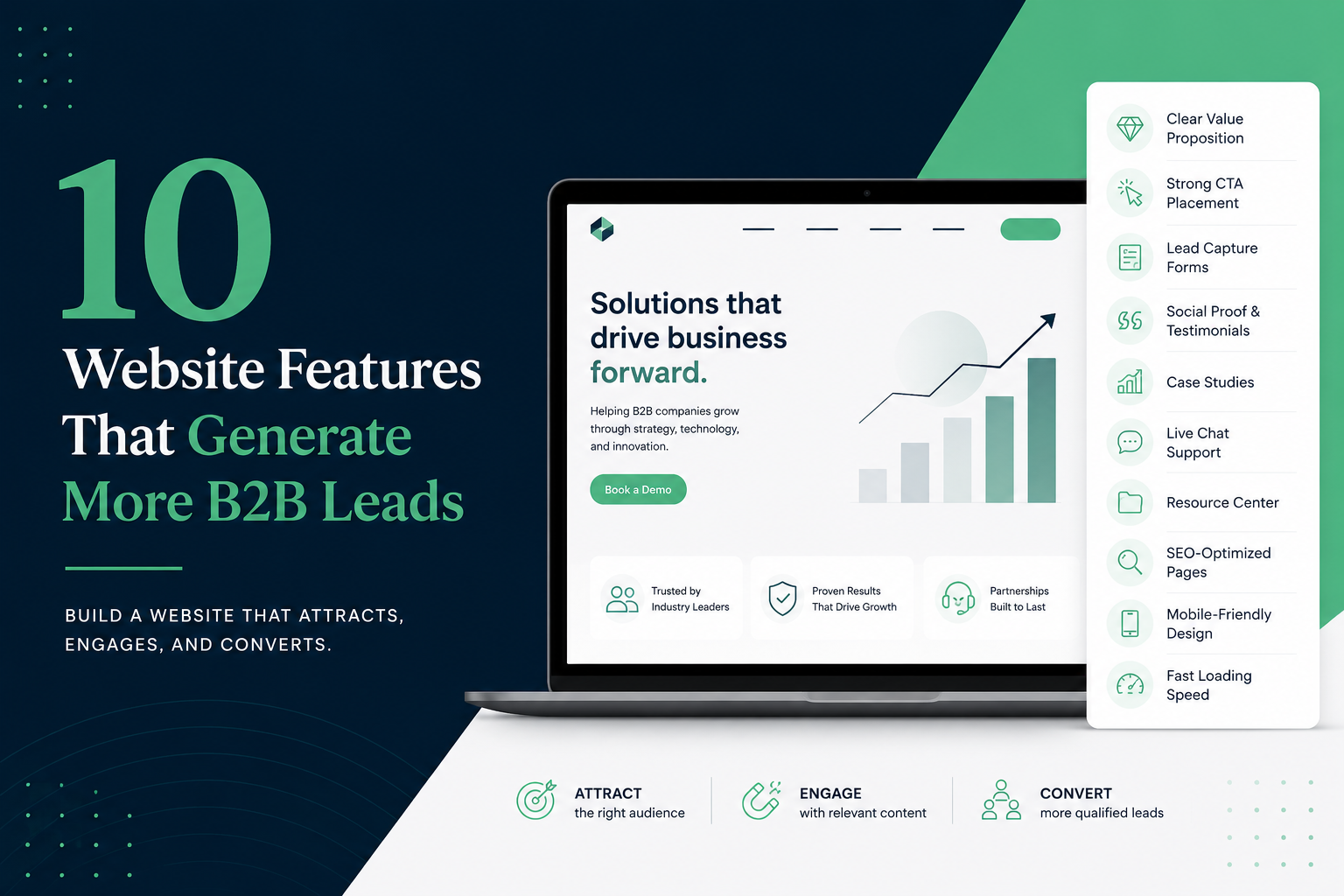
Here are the ten features that generate more B2B leads and why each one matters more than most manufacturers realize.
Why B2B Buyers Judge You Before They Ever Call
Buyers today do most of their research before making contact. They compare vendors, check credentials, and shortlist companies quietly. By the time someone fills out your form or messages you on WhatsApp, they have usually already decided whether you’re worth talking to.
This shift matters most for manufacturers and exporters in North Haryana. Your buyer might be in Chennai, Mumbai, or Germany. They have never met you. They don’t know your reputation in the local science market or the timber trade. Your website is the only thing standing between your product and their decision.
If your site looks outdated, has no proof of credibility, or makes it hard to take the next step, the buyer moves on. Quietly. You never even find out you lost the deal.
A website that only shows your products is a catalogue. A website built for leads is a salesperson that never sleeps.
The 10 Features That Generate More B2B Leads: A Deep Overview
1. Individual Pages for Each Product or Service
Most manufacturer sites cram everything onto one “Products” page. A buyer searching for “brass hardware fittings exporter” will never find you if that exact phrase doesn’t exist anywhere on your site.
Every product category deserves its own page. It’s own set of keywords that match how buyers actually search. This alone can double the number of search terms your site ranks for.
2. Visible Trust Signals and Certifications
ISO marks. BIS certification. Export licenses. Government supply history. Client logos. These need to sit where a buyer sees them in the first ten seconds, not buried on an “About Us” page nobody clicks.
A buyer comparing five vendors will eliminate the ones that give them nothing to verify. Trust signals aren’t decoration. They’re the reason a stranger picks up the phone.
3. A WhatsApp Click-to-Chat Button
Indian B2B buyers overwhelmingly prefer WhatsApp over email or contact forms. It feels faster and more personal. A floating WhatsApp button, visible on every page, removes friction at the exact moment someone is ready to ask a question.
Sites without this option lose buyers who simply won’t fill out a form. They’ll go find someone whose number is one tap away.
4. A Clear, Short Callback Form
Long forms kill conversions. Name, phone, and a one-line message field is usually enough. Every extra field you add is a reason for a busy procurement manager to abandon the form halfway through.
Test your own form on a phone. If it takes more than 20 seconds to fill, it’s costing you leads.
5. Real Case Studies
A logo says “we worked with them.” A case study says, “Here’s exactly what we solved and what changed.” Buyers doing serious research want the second version. A short write-up with the problem, what you delivered, and the outcome is more convincing than any sales pitch.
If you don’t have detailed case studies yet, even a two-paragraph summary with real numbers beats a logo wall. This single gap, no proof beyond a logo wall, is one of the most common reasons we’ve found Indian small business websites fail to generate leads despite getting steady traffic.
6. A FAQ Section That Answers Real Objections
Every buyer has the same handful of questions before they commit. Minimum order quantity. Lead time. Export documentation. Payment terms. Answering these directly on your site, instead of forcing someone to ask, removes hesitation and speeds up the decision.
Structured FAQ content also tends to show up directly in search results, which means more visibility without extra effort.
7. Fast Mobile Load Speed
Most B2B research today starts on a phone, even for large purchase decisions. A site that takes six seconds to load on mobile loses a meaningful share of visitors before the page even finishes rendering. Compressed images, a lightweight theme, and basic technical cleanup fix most of this.
8. A Blog or Content Section
A five-page brochure site only serves buyers who are already ready to call. Most buyers aren’t there yet. They’re comparing options, researching specifications, or trying to understand what “good” looks like in your category.
A blog answering their real questions keeps them on your site longer and builds trust before they ever reach out. It also gives Google far more content to rank, which brings in buyers who’ve never heard your company name. This is really one piece of a larger system. If you want to see how website, SEO, content, and follow-up connect, our complete growth stack guide lays out the full picture.
9. A Live Response System
Speed matters more than most manufacturers realize. Research on B2B response times consistently shows that the first vendor to respond wins a disproportionate share of deals, often regardless of price. A chat widget, an auto-reply on WhatsApp, or even a same-day callback commitment displayed clearly on the site all help you win the moment a buyer is paying attention.
10. Forms That Feed Into a CRM
A lead that lands in a shared email inbox or a WhatsApp group often gets forgotten within days. A basic CRM setup logs every inquiry, reminds your team to follow up, and lets you see exactly which channel is bringing in business. Most manufacturers lose leads not from lack of interest, but from lack of follow-up.
Websites With These Features vs. Without Them
| What Changes | Without These Features | With These Features |
|---|---|---|
| Monthly inquiries | 2 to 5, mostly referral | 20 to 40+, from search and direct traffic |
| Buyer trust on first visit | Low, nothing to verify | High, certifications and proof visible instantly |
| Mobile drop-off | High, slow load and long forms | Low, fast and simple to act on |
| Follow-up rate | Inconsistent, leads forgotten | Structured, every lead logged and tracked |
| Search visibility | Ranks for almost nothing | Ranks for dozens of product and buyer-intent terms |
The Trends Shaping B2B Websites in 2026
A few shifts are worth watching if you’re planning updates this year.
AI-assisted search is changing how buyers find vendors. Buyers increasingly ask AI tools to shortlist suppliers before they ever open Google. Sites with clear, well-structured content, real FAQs, and specific answers get picked up more often in these results than vague brochure pages.
Mobile-first research is now the default, not the exception. Even large institutional buyers are doing initial vendor research from a phone, often outside working hours.
Buyers expect self-service information. Pricing ranges, lead times, certifications, and specifications displayed upfront reduce back-and-forth and speed up decisions. Buyers who have to ask for basic information often just move to a competitor who has already answered it.
Local manufacturing hubs are getting more digital attention. As more Ambala, Yamunanagar, and Panchkula manufacturers slowly go online, early movers are capturing disproportionate visibility. The businesses that build these features first will hold that advantage for years, not months.
Why This Matters More for North Haryana Manufacturers Specifically
Ambala’s scientific instrument cluster, Yamunanagar’s plywood and hardware industry, and Panchkula’s growing service sector all share the same problem. Strong products, decades of reputation, and almost no digital presence built to convert.
Competition in these clusters is still catching up online. That’s an advantage, not a warning. A manufacturer who builds these ten features that generate more B2B leads today is competing against very few others who’ve done the same. In two years, that gap will close. The businesses that moved early keep the visibility they built. If you’re specifically in the scientific instruments space, our industry page for scientific instrument marketing goes deeper into what this looks like for your exact buyers.
What This Looks Like Once Exports Enter the Picture
Ravi’s business supplies a few exporters, which changes the equation further. International buyers can’t visit your factory before deciding to trust you. They rely entirely on what your website, your certifications, and your documentation tell them upfront. A missing export license badge or an unclear MOQ section can quietly end a deal before a single email is exchanged. If your business ships outside India, our export industry ecosystem page covers what changes when international buyers are part of your pipeline.
None of this needs to happen overnight. Start with the features that plug the biggest hole in your current site, then build out the rest over a few months.
Your product already earns trust in person. Your website needs to earn it in ten seconds, from a stranger who has never met you.
Want to see which of these ten features your website is missing?
We’ll review your current site and show you exactly where leads are slipping through.
Or message us directly on WhatsApp: +91-81689-62753
FAQs
Do I need all ten features that generate more B2B leads at once?
No. Start with the ones that fix the biggest gap first, usually trust signals, a WhatsApp button, and a short callback form. These three alone often lift inquiries within weeks. The rest can be added in phases.
My website already has a contact form. Isn’t that enough?
A contact form captures a lead only if the buyer already trusts you enough to fill it out. Most buyers leave before reaching that point because the site gave them no reason to stay. The form is the last step, not the whole system.
How long before these changes show results?
Trust signals, WhatsApp buttons, and shorter forms can lift conversions almost immediately, often within days of going live. SEO-dependent features like product pages and blog content take longer, usually three to six months, but compound over time.
Is this only useful for manufacturers?
No. These principles apply to any B2B business, including exporters, healthcare suppliers, and service providers. The details change slightly by industry, but the core idea stays the same: reduce friction, build trust fast, and never lose a lead to poor follow-up.
We get most of our business through IndiaMART. Do we still need this?
Yes. IndiaMART puts you next to ten competitors on the same page. Your own website is the only place where you control the story completely, and it’s often the first thing a serious buyer checks after finding you elsewhere.
What does it cost to add these features to an existing website?
It depends on how much of the current site can be reused. Trust signals, a WhatsApp button, and a shorter form are usually quick and low-cost additions. Product pages, a blog, and CRM integration take more work since they involve content and setup, but they’re also the features that keep paying off for years.
Can I add these features myself, or do I need a developer?
Simple things like a WhatsApp button or shortening a form can often be done without a developer, depending on your website platform. Product pages, CRM integration, and technical speed fixes usually need someone who knows the backend, especially on WordPress sites with custom themes.
We already rank on Google for our company name. Isn’t that enough?
No. Ranking for your own name only helps people who already know you exist. The real opportunity is ranking for what buyers search when they don’t know your company yet, things like your product category, your city, or your specialization. That’s where product pages and blog content do the real work.
Should we redesign the whole website, or just add these features?
Most of the time, a full redesign isn’t necessary. If your site’s structure is reasonable, adding these ten features on top of it gets you most of the benefit without the cost or downtime of starting over. A redesign makes sense only if the current site is very old or genuinely broken.
How do we know which feature to prioritize first for our business?
Look at where buyers are dropping off right now. If people visit but never contact you, start with trust signals and a shorter form. If you’re not getting visitors at all, start with product pages and content. A short audit usually makes this obvious within a day.
A digital strategist building scalable ecosystems for many kinds of businesses. Focused on turning online presence into structured, revenue-driven growth systems. As a researcher, Nishant has done a lot of experiments, and through learning from them, he now founded GrowNerds so that he could provide a scalable digital ecosystem to every type of business.
Leave a Reply