Rohit runs a diagnostic and lab equipment distribution business out of Chandigarh. He supplies hospitals, pathology labs, and diagnostic centres across Punjab and Haryana. Four salespeople. Ninety-odd inquiries a month, coming in from the website, IndiaMART, and old-fashioned referrals.
Business was growing. So Rohit did what most owners do. He started interviewing for three more sales roles, because more leads should mean more people, right?
Then he looked closer at what his four-person team was actually doing all day. Chasing. Re-explaining product specs to leads who had already read the brochure twice. Calling people who were not ready to buy for another six weeks. Forgetting to follow up with the ones who were.
The problem was never the lead volume. It was that every lead, hot or cold, ready or not, was getting the exact same amount of manual attention. Or none at all.
GrowNerds built an automated lead nurturing system for Rohit’s business instead. No new hires. The same four salespeople, now only talking to leads who were actually warm.
The result, in one quarter:
- 2.8x more sales-ready conversations per rep, per month
- The average sales cycle dropped from 34 days to 19 days
- ₹14.6 lakh in additional closed business, with zero additional headcount
Rohit never opened those three job listings. This post explains exactly why and how you can do the same thing for your own sales team.

The Real Cost Of Growing Sales By Hiring
Most Indian business owners default to the same growth math. More leads are coming in, so add more people to handle them. It feels logical. It is also the most expensive way to solve the problem.
Here is what it actually takes to add one salesperson in a mid-sized Indian B2B or service business, compared to what automated lead nurturing costs.
| Cost Component | Hiring A Salesperson | Automated Lead Nurturing |
|---|---|---|
| Monthly cost (India average) | ₹25,000 – ₹60,000 salary + incentives | ₹5,000 – ₹20,000/month |
| Time to full productivity | 3 to 6 months ramp-up | 2 to 4 weeks to go live |
| Consistency | Varies by mood, workload, and memory | Same follow-up, every single lead |
| Works after office hours | No | Yes, 24/7 |
| Risk if the person quits | Pipeline knowledge walks out the door | The system stays exactly as it was |
| Scales to 5x leads? | Only by hiring 5x more people | Yes, with no extra cost |
This is not an argument against hiring salespeople. Good closers are still essential. It is an argument against using headcount to solve a follow-up problem, since software can do it better and more cheaply. If you are unsure whether your business is even set up to capture and convert the leads you already have, start with why 90% of Indian small business websites fail to generate leads before adding anyone to the payroll.
What Automated Lead Nurturing Actually Means
- Lead nurturing is not the same as lead generation.
- Lead generation gets someone into your system.
- Lead nurturing is what happens to that person after the emails, WhatsApp messages, and follow-ups that move them from curious to convinced, without a human typing every single message.
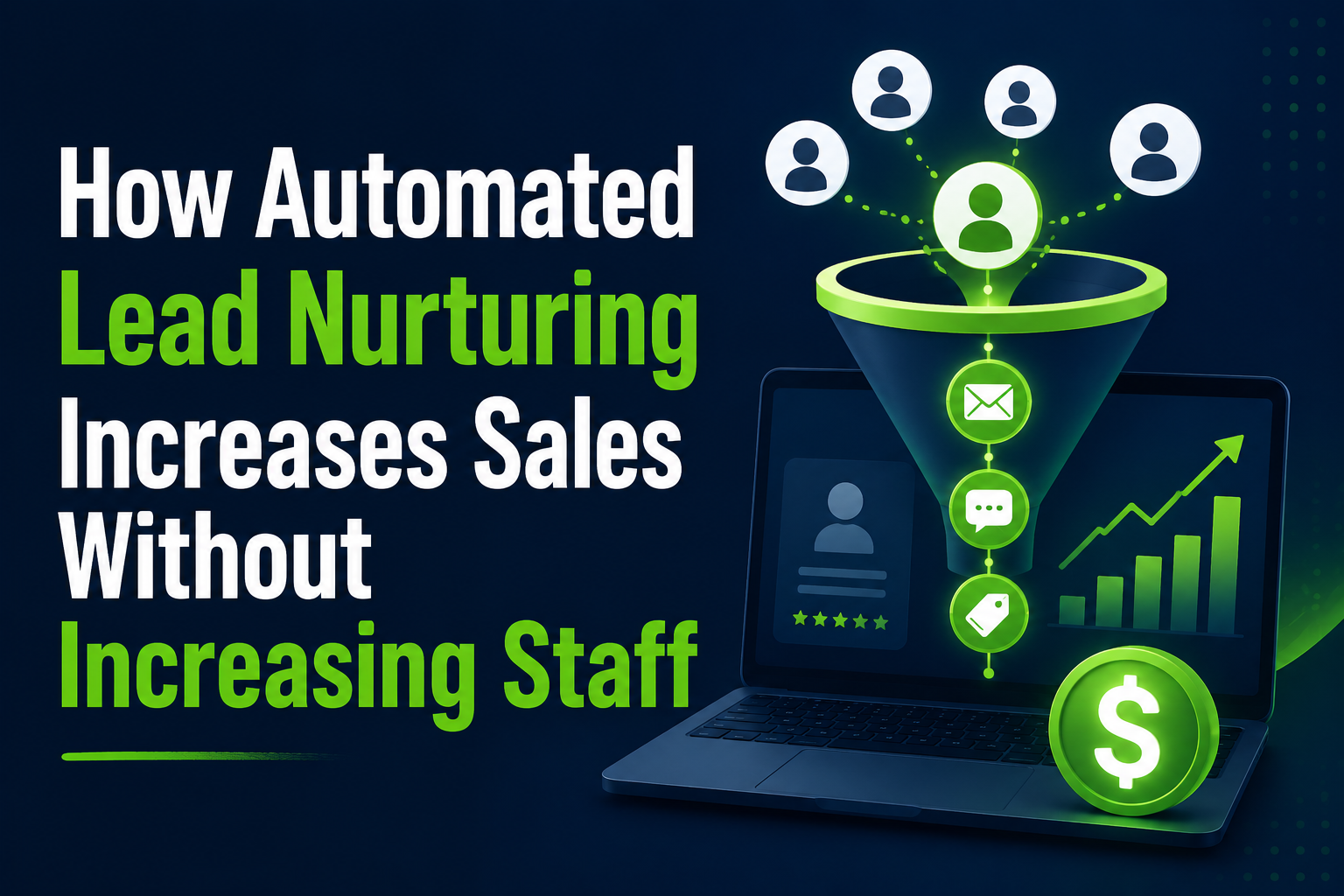
Automated lead nurturing means this entire sequence runs on rules you set once. Someone downloads your catalogue, they enter a nurture track. Someone visits your pricing page twice, the system flags them as sales-ready and alerts your rep. Someone goes quiet for ten days, a re-engagement message goes out on its own.
We have already covered the broader picture of the 10 marketing automations every growing business needs. Lead nurturing is one of those ten, arguably the one with the most direct impact on revenue, because it changes what your sales team spends its day doing.
The Data Behind Automated Lead Nurturing
This is not a trend built on guesswork. The numbers on nurtured versus non-nurtured leads have been consistent for years, and they hold up in Indian markets too.
| Metric | Data Point |
|---|---|
| Website visitors ready to buy on first visit | Only 4% |
| Nurtured leads vs non-nurtured purchase size | 47% larger |
| Response rate: nurture emails vs standalone blasts | 4 to 10 times higher |
| Sales reps hitting quota at companies that nurture well | 9% more |
| Deals lost to whichever vendor replies first | 35% to 50% of all sales |
| Email-to-meeting rate: behaviour-triggered vs calendar-based nurture | 3 to 5 times better |
Sources: HubSpot lead nurturing research, The Pedowitz Group.
Look at that last stat again. Behaviour-triggered nurturing, where the system responds to what a lead actually does instead of just counting days since sign-up, performs three to five times better than a basic drip sequence. That difference is exactly what separates a system that quietly grows your revenue from one that just adds noise to someone’s inbox.
Why Nurtured Leads Need Fewer Salespeople To Close
Here is the part most business owners miss. A sales team does not get maxed out by lead volume. It gets maxed out by unqualified conversations.
When nurturing is automated, three things change at once:
- Education happens before the call. By the time a rep speaks to a lead, that person already understands the product, the pricing range, and the basic use case. The rep is closing, not explaining.
- Cold leads stay off the phone list. Leads that are not ready get looped into a nurture track instead of eating up a rep’s cold-call hours.
- Sales-ready signals get flagged automatically. Lead scoring tells your team exactly who to call today, instead of your team guessing or working the list top to bottom.
The outcome is fewer, better conversations per rep. That is the mechanism behind “more sales without more staff.” It is not magic. It is math. One rep having ten qualified conversations a day will always outsell three reps having thirty unqualified ones.
Two Businesses, Two Different Automated Nurture Systems
Rohit’s story is one example. Automated lead nurturing looks different depending on the industry, the buyer, and the sales cycle. Here are two more GrowNerds builds, from two very different verticals.
Case Study: A Scientific Instrument Manufacturer In Ambala
A laboratory equipment manufacturer in the Ambala cluster was getting steady inquiries from IndiaMART and their website, but their two-person sales team could not chase everyone with the speed institutional buyers expect. We built a five-touchpoint automated nurture sequence tied to their CRM, triggered the moment a form was submitted, with content built around comparison guides and past institutional deliveries.
| Metric | Before | After 4 Months |
|---|---|---|
| Leads followed up within 24 hours | 41% | 96% |
| Quote-to-order conversion rate | 12% | 27% |
| Sales headcount | 2 | 2, unchanged |
The full context on why this cluster needs this kind of system so urgently is in how Ambala instrument manufacturers are losing ₹50 lakh a year without a lead system.
Case Study: A Multi-Location Diagnostics Chain
A diagnostics chain with three centres in Punjab was fielding patient inquiries through Google, Justdial, and walk-in referrals, but front-desk staff had no time to follow up on people who called and did not book. We automated a WhatsApp-first nurture flow: instant acknowledgement, a reminder at 48 hours, a health-package comparison at day 5, and a booking link throughout.
| Metric | Before | After 3 Months |
|---|---|---|
| Inquiry-to-booking conversion | 22% | 51% |
| Front-desk hours spent on manual follow-up weekly | 18 hours | 3 hours |
| New front-desk hires | — | 0 |
Healthcare buyers behave differently from B2B manufacturing buyers, but the underlying principle holds. If you run a healthcare or pharma business, our healthcare digital ecosystem page covers the full picture.
How An Automated Nurture Engine Actually Runs
Every automated lead nurturing system, regardless of industry, follows roughly the same skeleton. Here is what it looks like stage by stage.
| Stage | Trigger | What Happens |
|---|---|---|
| Awareness | Form fill or first WhatsApp message | Instant acknowledgement, catalogue or brochure link |
| Consideration | No reply after 2 to 3 days | Comparison content, case study, or FAQ answer |
| Sales-Ready Signal | Pricing page visit, repeat visit, or reply | Lead scored hot, rep gets an instant alert |
| Re-Engagement | 14 days of silence | Low-pressure “still exploring options?” message |
| Post-Sale | Order confirmed | Check-in sequence, referral or repeat-order ask |
Notice that a human only enters the picture at the sales-ready stage. Every earlier stage runs on rules. That is precisely why one rep can now do what previously needed two or three.
Hiring vs Automating: The Direct Comparison
| Question | Answer |
|---|---|
| Do I still need salespeople? | Yes. Automation qualifies leads. Humans still close them. |
| What grows instead of headcount? | The number of qualified conversations each rep has per day. |
| When should I hire instead of automate? | When conversation volume, not follow-up speed, is the actual bottleneck. |
| Can both work together? | Yes, and this is the ideal setup for most growing Indian businesses. |
This Is Part Of A Bigger System
Automated lead nurturing does not work in isolation. It needs leads flowing in from a website that actually converts, and it needs a follow-up culture that does not let cracks form elsewhere. We have written about both of these problems in detail: the silent reason Indian businesses lose good leads every day covers the follow-up gap specifically, and 10 marketing automations every growing business needs shows where nurturing fits alongside the other nine.
At GrowNerds, lead nurturing automation is built as one connected layer of the full digital growth ecosystem, not a bolt-on tool. Your website captures the lead. SEO and content bring the right traffic in the first place. Automation makes sure nobody falls through the cracks after that.
- We build the nurture sequence around how your specific buyer actually behaves, not a generic template.
- We connect it to your CRM so your sales team sees the full lead history before they ever dial.
- We measure it against revenue, not opens and clicks.
Frequently Asked Questions
1. Does automated lead nurturing actually reduce the need to hire salespeople?
Yes, indirectly. It does not replace your sales team. It removes the unqualified, repetitive work from their day so each rep can handle more real conversations without you adding headcount.
2. Is this only useful for B2B businesses?
No. Healthcare, diagnostics, fitness, education, and service businesses all benefit. Anywhere a lead needs time and a few touchpoints before they buy, automated nurturing shortens that gap.
3. How is lead nurturing different from just sending more emails?
Regular email blasts go to everyone at once. Lead nurturing responds to what a specific person did, a form fill, a page visit, or silence, and sends the message that fits that exact moment.
4. How long before I see results from automated lead nurturing?
Most businesses see a measurable shift in follow-up speed and reply rates within the first 30 days. Full sales-cycle impact typically shows up in the 60 to 90 day range.
5. What does automated lead nurturing cost for an Indian business?
Most setups run between ₹5,000 and ₹20,000 a month, depending on channels used and lead volume, far below the cost of a single new sales hire.
6. Can WhatsApp be part of an automated nurture sequence in India?
Yes, through the official WhatsApp Business API. For Indian buyers, WhatsApp nurturing often outperforms email because of how much faster people respond on it.
7. Will my leads feel like they are talking to a robot?
Not if it is built correctly. A well-built nurture sequence responds to real behaviour, so the message feels timely and specific rather than generic and automated.
8. Can GrowNerds set this up for my business?
Yes. We build the full sequence, connect it to your CRM and WhatsApp, and manage it as part of your digital growth ecosystem. Book a free strategy call to see what it would look like for your business.
A digital strategist building scalable ecosystems for many kinds of businesses. Focused on turning online presence into structured, revenue-driven growth systems. As a researcher, Nishant has done a lot of experiments, and through learning from them, he now founded GrowNerds so that he could provide a scalable digital ecosystem to every type of business.
Leave a Reply