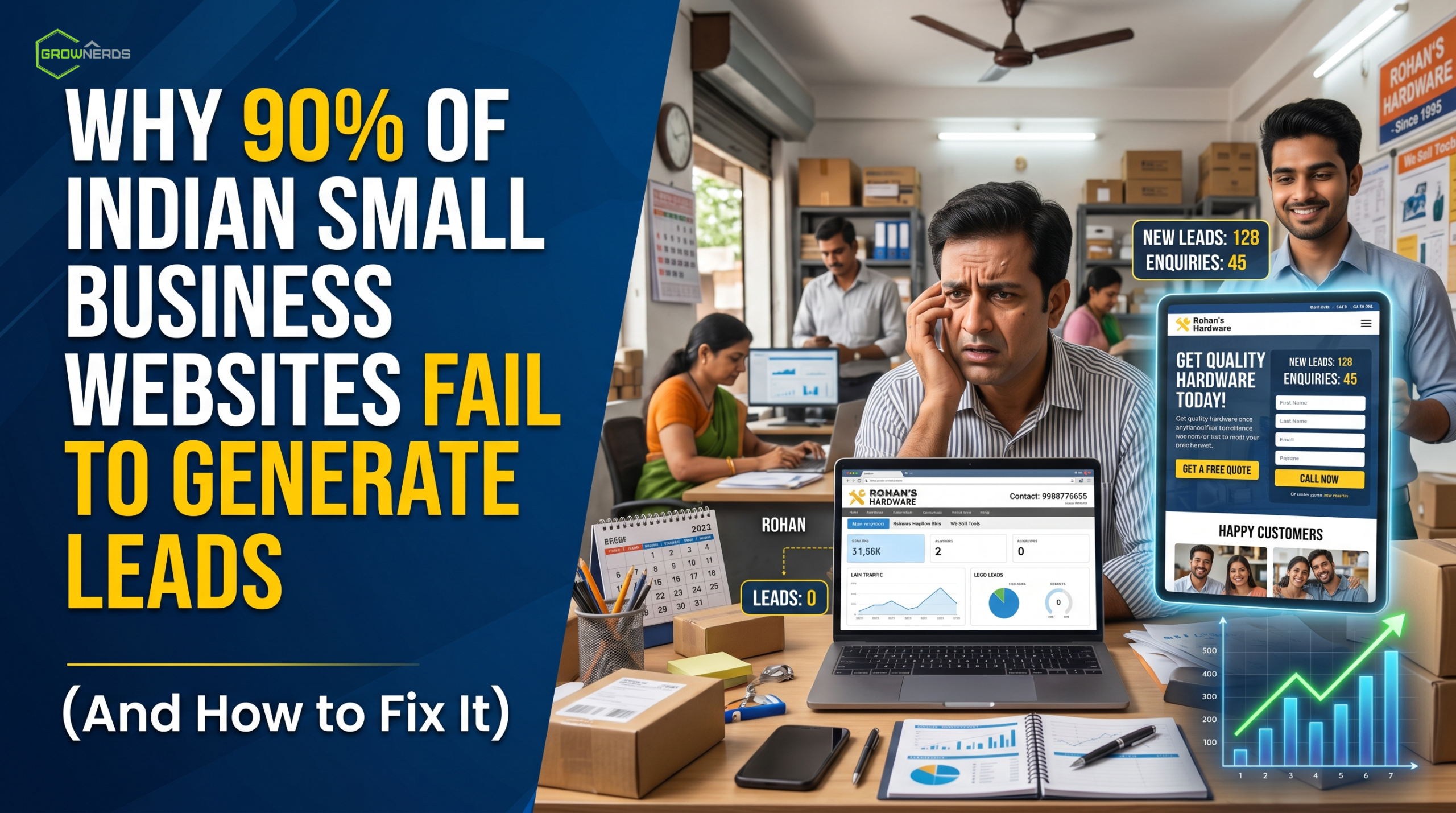
Here is a scene that plays out every single month across India.
A business owner spends ₹30,000 to ₹150,000 building a website. The agency delivers something clean and mobile-friendly. The site goes live. Family and friends get the link. A few people visit.
And then nothing happens.
No calls, no form is filled, no WhatsApp messages, zero leads.
Six months later, the website is still live. It still looks decent. But it has not generated a single rupee of business.
This is not rare. It is extremely common. And it happens to businesses across every industry—coaching centers in Chandigarh, furniture makers in Rajasthan, consultancies in Mumbai, and clinics in Hyderabad.
The sad part? Most of these businesses are not failing because of bad products. They are failing because their website is not built to generate leads. There is a difference between a website that exists and one that works.
This guide breaks down the seven reasons Indian small business websites fail to get leads. More importantly, it tells you exactly what to do about each one.
First, Understand the Core Problem
Most Indian business owners treat a website like a digital brochure. A place to say, “We exist. Here is what we do. Here is our phone number.”
That mindset is the root of the problem.
A website that generates leads is not a brochure. It is a system that needs to be found on Google, needs to communicate value clearly, and needs to earn trust. And it needs to make the next step feel easy.
When even one of these pieces is missing, leads dry up, even on websites that look expensive and professional.
Here are the seven reasons that piece is missing — and what to do about it.
Reason 1: Your Website Is Invisible on Google
This is the single biggest problem. And it affects the majority of Indian small business websites.
Think about how your customers find you. If they already know your name, they search for it directly. But what about the customer who has never heard of you?
The purchase manager is searching for “laboratory equipment supplier India.” The HR director is looking for a “corporate training company in Pune.” The homeowner is typing “interior designer Mohali.”
If your website does not appear for those searches, you simply do not exist for that buyer.
Here is the scale of the problem. According to research from 6sense, 81% of B2B buyers already have a preferred vendor before they ever contact anyone. That preference is built during the online research phase — the phase when they are Googling, reading, and comparing. If you are not showing up during that phase, the decision is made without you.
India makes this even more urgent. The Internet and Mobile Association of India reports that India is set to exceed 900 million internet users, with mobile search dominating buyer behavior across both urban and rural markets.
What typically goes wrong:
- One generic “services” page instead of individual pages for each service.
- No location-based keywords like “digital marketing agency Mohali.”
- Missing or incomplete Google Business Profile.
- Pages are loading in over four seconds on mobile.
- No blog or content to rank for buyer questions.
What to fix:
Build individual pages for every service you offer. Use the language your buyers actually type into Google. Fully complete your Google Business Profile with photos and reviews. Compress images and fix page speed. Start publishing content that answers buyer questions in your niche.
SEO takes three to six months. But businesses that start today are the ones ranking next year.
Reason 2: Your Website Talks About You, Not Your Customer
Open almost any Indian small business website and read the homepage. It usually says something like:
“We are a leading provider of XYZ services with 10 years of experience.”
Now ask yourself honestly—does your customer care about that sentence?
No. What they care about is whether you can solve their specific problem. What they want to know, within the first few seconds on your site, is “Is this for me?”
Most Indian business websites fail that test. They are written from the inside out: company history, achievements, and credentials. Not from the outside in, customer problem, desired outcome, and proof that you deliver it.
The quick test:
Read your homepage’s first three sentences. Count how many times “we,” “our,” and “us” appear versus “you” and “your.”
If “we” win, your website is talking about you. Visitors leave websites that talk about themselves.
What to fix:
Rewrite your headline around the customer’s problem or desired outcome.
- Before: “We are a digital marketing agency with 5 years of experience.”
- After: “Get more leads from your website — without spending more on ads.”
Follow that with two or three sentences: who you help, what problem you solve, and what the result looks like. Put the customer at the centre of every page.
Reason 3: There Is No Clear Call to Action
Even if someone reads your content and likes what they see, they will not act unless you tell them what to do next.
This sounds obvious. Yet most Indian small business websites either have no visible CTA at all, or they have too many and create confusion.
Common mistakes:
- Phone number buried in the footer with no other contact path.
- Contact form with ten fields just to send a basic inquiry.
- Four buttons on the homepage with no clear primary action.
- No WhatsApp button — despite WhatsApp being India’s preferred first contact channel.
Why too many choices kill conversions:
Research consistently shows that more options lead to fewer decisions. This is the paradox of choice. On a website, five different CTAs often convert worse than one clear, prominent one.
What to fix:
Pick one primary action—a free consultation, a WhatsApp message, or a callback request. Make it visible before the visitor scrolls. Repeat it at the bottom of every service page. Keep it low-friction: “Book a Free 15-Minute Call” converts better than “Contact Us.”
Add a WhatsApp click-to-chat button. A large portion of Indian B2B buyers prefer WhatsApp as their first point of contact. Removing that friction directly increases inquiries.
Reason 4: The Website Has No Trust Signals
A visitor who finds you through Google knows nothing about you.
Their default response is skepticism. Not hostility — just natural caution. They are not going to fill in your form or call your number until they feel safe enough to do so.
Trust in a website is built through specific, visible signals. Most Indian small business websites are missing almost all of them.
What most websites are missing:
Client logos—recognizable names you have worked with, shown prominently on the homepage.
Specific testimonials — not “Great service!” but “They increased our leads by 3x in six months—Ramesh Kumar, ABC Manufacturing, Delhi.”
Case studies — before-and-after stories with real numbers.
Certifications—ISO, industry memberships, government approvals, visible on every service page.
Team photos with real names—actual faces build trust that stock photos never will.
Exact numbers—”Helped 50+ businesses” is more credible than “Helped many businesses.”
According to McKinsey’s 2024 B2B Pulse Survey, the company website is the most frequently used touchpoint across the entire B2B buying journey — more than in-person sales or video calls. That means your website’s credibility signals are doing more selling than your team is.
What Indian buyers specifically look for:
Two trust signals carry the most weight in Indian B2B deals. First, logos from recognizable client companies. Second, location-specific proof — evidence that you have served businesses in their city or their industry. Adding these to your homepage can meaningfully shift conversion rates.
Reason 5: The Website Is Not Built for Mobile
India is a mobile-first country. This is not a trend—it is a structural reality.
Over 1.05 billion Indians access the internet via mobile phones, according to Statista. The majority of all web traffic in India comes from smartphones. Most buyers do their research on a phone during a commute, a lunch break, or between meetings.
Yet a large number of Indian small business websites are still built primarily for desktop. Mobile is treated as an afterthought.
What a broken mobile experience looks like:
- Text too small to read without zooming.
- Buttons too close together to tap without hitting the wrong one.
- Forms that are a struggle to fill out on a touchscreen.
- Pages taking more than four seconds to load on a 4G connection.
- Phone numbers that are not tap-to-call links.
Each of these sends visitors away. On mobile, patience is thin, and attention is short.
What to fix:
Test your website on an actual Android device, not Chrome’s desktop simulator. Run it through Google’s PageSpeed Insights. Make every phone number a clickable link. Ensure buttons are large enough to tap comfortably. Keep forms short and easy to complete with a thumb.
If your website is more than three years old and has not been updated since, it is almost certainly failing mobile users in ways you have not noticed yet.
Reason 6: No Content Answers Buyer Questions
Most Indian business websites have five to seven pages: Home, About, Services, Team, and Contact. Sometimes a gallery. That is it.
This structure only speaks to people who are already at the end of their buying decision, someone ready to call right now. It does nothing for the much larger group of people still researching, comparing, and figuring out what they need.
90% of B2B buyers research two to seven websites before making a purchase decision. They are consuming content, reading comparisons, and looking for answers. If your website has nothing to offer them at that stage, a competitor’s website does.
Why content matters:
Content like blog posts, FAQs, case studies, and guides does several things at once. It helps your website rank for more search queries, builds trust by demonstrating real expertise, and keeps visitors on your site longer. And it gives you something valuable to share on LinkedIn and WhatsApp.
The compounding effect is powerful. A blog post published today can generate traffic and leads for years.
What kind of content works:
The most effective content answers the exact questions your ideal customers are already asking. Think about what your clients ask you in the first sales conversation — those questions are your content topics.
For an accounting firm: “When does a business need to register for GST?” For a logistics company: “What is the difference between FTL and LTL shipping?” For a digital agency: “How long does SEO take to show results?”
Answer those questions in detail. Publish them consistently. Watch your organic traffic grow.
Reason 7: There Is No System to Follow Up With Visitors
Here is a hard truth: even when someone finds your website, reads your content, and genuinely likes what they see, most of them will not contact you on that first visit.
They get distracted, plan to come back, bookmark the page, and forget. They meant to WhatsApp you, and then something came up.
Most Indian small business websites have absolutely no mechanism to re-engage those people. Once they leave, they are gone forever. No email list, no retargeting, and no chatbot captured their question. Nothing.
The result: a large share of your potential leads never convert — not because they were not interested, but because there was no system to bring them back.
What a basic follow-up system looks like:
Email capture: Offer a free guide, checklist, or consultation in exchange for an email address. Once you have the address, you can stay in touch and convert them when they are ready.
WhatsApp broadcast: For Indian SMBs, a WhatsApp Business account with an opt-in list is one of the most effective follow-up channels available.
Retargeting ads: A small budget on Facebook or Google lets you show ads specifically to people who visited your site but did not convert. They are warm. They already know you. The cost per lead is far lower than cold traffic.
Chatbot or live chat: Even a basic chatbot can capture questions and contact details at any hour, including 2 AM when your team is asleep.
None of this needs to be complex or expensive. But without at least one of these systems, you are leaving a significant chunk of your potential business on the table every single month.
A Special Note for Scientific Instrument Manufacturers in Ambala
If you are a manufacturer of laboratory or scientific instruments in Ambala, this entire guide applies to you, but with extra urgency.
Ambala has over 800 scientific instrument manufacturing units. Most of them have a website. Very few of them have a website that actually generates B2B leads. Lab directors, procurement heads at hospitals, government research institutions: these buyers are all starting their search online now. If your product pages are not findable on Google, if your website has no trust signals, or if there is no WhatsApp button, they find a competitor instead.
We have written a detailed guide on exactly how Ambala’s scientific equipment manufacturers can fix this: Digital Growth Ecosystem for Ambala Scientific Instrument Manufacturers →
It covers B2B lead generation strategies, digital branding, SEO for industrial keywords, and how to compete against cheaper imports by building credibility online. If you are in this industry, that guide is worth reading alongside this one.
What a Lead-Generating Website Actually Looks Like
A website that consistently generates leads is not the most beautiful or the most expensive one. It is the one that gets all seven fundamentals right.
A business that fixes all seven is not just building a better website. They are building a growth system — one that works continuously to attract, engage, and convert the right customers.
The Common Thread: Your Website Is Only Part of the System
After working with businesses across industries, one pattern becomes clear. The websites that generate the most leads are rarely the most technically impressive.
They are the ones embedded in a complete digital ecosystem. The website is connected to an active Google Business Profile. SEO is pulling in targeted traffic. Content is building trust over time. Social media keeps the brand visible. And automation follows up with prospects, so no lead goes cold.
This is the difference between a digital presence and a digital growth system.
Most Indian businesses have the first. Very few have the second. And the gap between the two is where most of the revenue is hiding.
How GrowNerds Helps Indian Businesses Fix This
At GrowNerds, this is exactly what we build — not just websites, but complete digital growth ecosystems where every element works together to generate real business outcomes.
We start with a deep understanding of your business, your audience, and your market. Then we build or restructure your website to be found, trusted, and conversion-ready. We layer in SEO, content, and trust-building systems. And we connect everything with automation, so your digital presence works around the clock.
The businesses we work with are not the ones with the biggest budgets. They are the ones who are serious about growth and ready to build a system that lasts.
We will review your current digital presence, identify exactly where leads are being lost, and give you a clear plan to fix it.
FAQs
Why is my business website not getting leads in India?
The most common reasons are poor Google visibility, unclear homepage messaging, missing trust signals, and no clear call to action. In most cases, it is not one problem but a combination of several working against you at the same time.
How long does it take for a website to start generating leads?
For SEO-driven leads, expect three to six months. For improvements to messaging, CTAs, and trust signals, results can come much faster. Sometimes, within weeks of making the changes.
Does a small business in India really need a blog?
Yes, especially if organic traffic is a priority. Blog content helps your website rank for a wider range of search terms, builds credibility with buyers in the research phase, and gives you material to share on social media. Businesses that publish consistent, relevant content over twelve months typically see significantly more inbound traffic than those that do not.
What is the most important fix for a website not getting leads?
If your site gets traffic but no conversions, start with your CTA and trust signals. If your site gets very little traffic at all, start with SEO. In most cases, for Indian SMBs, SEO is the root issue because the traffic simply is not there to convert.
How does GrowNerds help businesses generate more leads online?
GrowNerds builds complete digital ecosystems—not just websites, but the full system around them: SEO, content strategy, branding, trust-building, and marketing automation. We work as a long-term growth partner. Everything is designed to generate real, measurable business outcomes.
A digital strategist building scalable ecosystems for many kinds of businesses. Focused on turning online presence into structured, revenue-driven growth systems. As a researcher, Nishant has done a lot of experiments, and through learning from them, he now founded GrowNerds so that he could provide a scalable digital ecosystem to every type of business.
Leave a Reply