
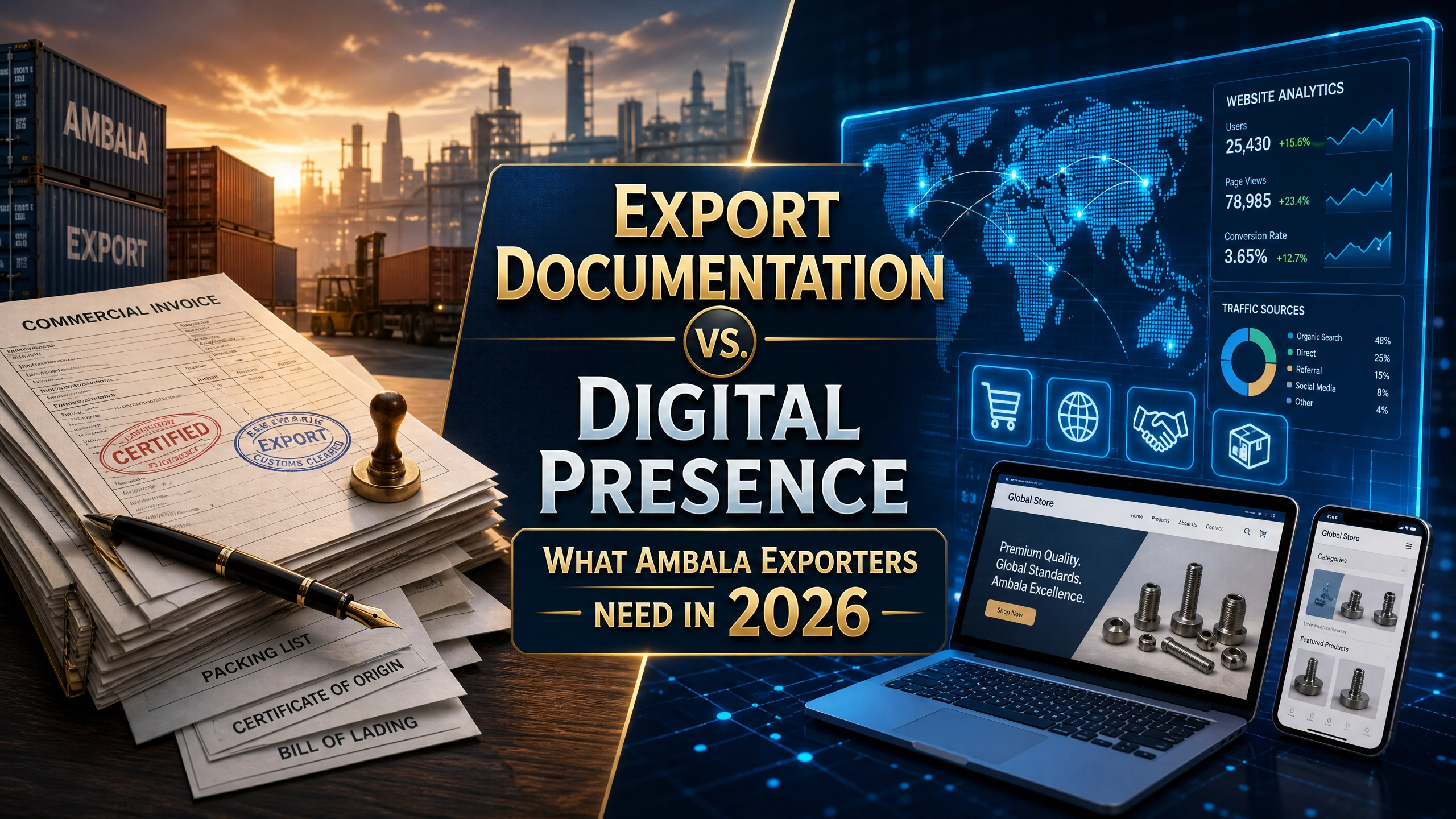
There is a scientific instrument exporter working out of Ambala Cantt. His IEC is active, GST and LUT filings are up-to-date, and the certificate of origin paperwork never gets flagged at customs. On paper, he is fully export-ready.
Last month, a buyer in Germany asked to see his company online before signing the order. There was no website. Just an IndiaMART listing with three photos and a phone number. The buyer moved to a competitor with a proper site, product specs, and a LinkedIn page. Same product. Same price. Different outcome.
This is playing out across Ambala’s scientific instruments cluster right now. Perfect documentation. No real digital presence for Ambala exporters. And it is costing genuine orders every single month.
The Real Cost of Looking Invisible
Research from 6sense’s Buyer Experience Report found that most B2B buyers are close to 70 percent through their purchase decision before they ever contact a supplier. By the time a buyer messages you on IndiaMART or emails your export ID, they have already shortlisted, compared, and half-decided who they trust. If you were not visible during that silent research phase, you were never really in the running.
This is not a small leak. It is the difference between quoting on a deal and never hearing about it at all. An Ambala exporter with strong documentation but a thin digital presence is not losing deals on price or quality. He is losing them before the conversation starts to a competitor the buyer found first and trusted faster.
Multiply that across a full export season, and RFQs from Germany, the Gulf, Southeast Asia, and the gap stops look like a marketing nice-to-have. It starts looking like the single biggest constraint on how much an Ambala manufacturer can actually export, regardless of how good the product is.

Documentation Gets You Cleared. It Doesn’t Get You Chosen.
Your IEC, GST registration, LUT, and Certificate of Origin exist for one reason. They prove to customs and the government that your shipment is legal. Every exporter needs them. There is no way around that, and there should not be. The DGFT portal lays out exactly what is required, and most Ambala manufacturers handle this part well. Decades of export experience means the paperwork is rarely the problem.
Here is a quick breakdown of what each core document actually does, in plain terms:
- IEC (Import Export Code): Your basic license to export at all, issued once by DGFT and valid for life.
- GST registration and LUT: Lets you export without paying IGST upfront on every shipment.
- Commercial Invoice: The billing document the buyer, customs, and your bank all rely on to match what was agreed.
- Certificate of Origin: Proves the goods were made in India, which can affect the import duty your buyer pays on the other end.
- Bill of Lading or Airway Bill: The shipping company’s receipt and proof that goods are actually moving.
None of these documents do anything to help a buyer find you in the first place, and none of them convince a stranger you are worth the risk of a first order. That work happens earlier, on a screen, before any invoice or shipping bill is ever raised.
What International Buyers Actually Check Before They Call
A procurement manager in Dubai or Rotterdam does not walk into your factory. They search your product category online, open three or four supplier profiles, and decide who is worth a phone call. What they look for is fairly consistent.
- A real website with product specs, not just a directory listing
- Visible certifications and export history
- A LinkedIn presence for the company and its founders
- Consistent information across every platform they check
- A way to send an inquiry that gets answered fast
If any of this is missing, buyers do not usually ask why. They just move to the next name on the list. This is what makes digital presence for Ambala exporters as important as the paperwork sitting in your files, not a nice extra on top of it.
Our guide to website features that generate B2B leads covers what a serious buyer expects to see on a supplier site, and most exporters are missing more of it than they realize.
Documentation-Only Exporter vs. Digital-Ready Exporter
| What Buyers See | Documentation-Only Exporter | Digital-Ready Exporter |
|---|---|---|
| First search result | Third-party portal listing only | Own website with product pages |
| Certifications | Mentioned in conversation only | Displayed with proof, on the site |
| Response time to inquiry | Days, depends on who checks WhatsApp | Automated first reply within minutes |
| Who owns the buyer relationship | The portal | The exporter |
| Differentiation from competitors | Looks identical to 50 other listings | Distinct brand, credibility signals visible |
Why Ambala Exporters Are Especially Exposed
Ambala’s scientific instruments cluster is one of the most concentrated manufacturing hubs of its kind in the country. That density is usually a strength. Here, it works against most exporters online, because hundreds of manufacturers rely on the same handful of portals with near-identical listings. A buyer scrolling through IndiaMART or ExportersIndia cannot easily tell one Ambala exporter from another.
We have written before about how Ambala instrument manufacturers lose real money without a lead system, and the export side of that problem is even sharper. A domestic buyer might give an unfamiliar supplier the benefit of the doubt. An international buyer, placing a large first order with a company they cannot visit in person, usually will not.
Add rising competition from Chinese manufacturers who invest heavily in polished, English-language websites and international SEO, and the gap widens further. Documentation proves you are legal. It does nothing to prove you are the better choice.
The Documentation Checklist vs. The Digital Presence Checklist
| Documentation Checklist | Digital Presence Checklist |
|---|---|
| IEC (Import Export Code) from DGFT | Own website with product and export pages |
| GST registration and LUT filing | Certifications and export history on display |
| Commercial invoice and packing list per shipment | RFQ form that routes to a real inbox |
| Certificate of Origin | Active LinkedIn company and founder profile |
| Bill of Lading or Airway Bill | Consistent details across portals and website |
| RCMC, where export benefits apply | SEO built for your target buyer countries |
Most Ambala exporters can tick off the left column without much trouble. Almost none can tick off the right column in full, and that gap is exactly where buyers are quietly deciding who they trust.
What a Real Digital Presence Looks Like
A digital presence for an exporter is not a brochure website with a contact number. It needs to do the same job your documentation does: prove you are legitimate, but do it before the buyer ever picks up the phone.
That means a website built around product specs and export capability, not vague service descriptions. It means certifications and past shipment history are shown clearly, not buried in a PDF you send only after someone asks. It means a form that captures an inquiry and triggers an instant reply, so a buyer emailing at 2 am from Dubai gets acknowledged before your competitor even wakes up.
Our Export Growth Ecosystem is built specifically for this. Website, country-specific SEO, LinkedIn presence, and RFQ automation, working together instead of as separate, disconnected pieces.
A 90-Day Plan to Build This Alongside Your Documentation
You do not need to pause export operations to fix this. Documentation and digital presence can be built in parallel, and most Ambala exporters can see real movement within a single quarter.
Days 1 to 30: Get the foundation live. A proper website with product specs, certifications, export history, and a working RFQ form. This alone moves you out of the “portal listing only” category and gives buyers something to verify you against.
Days 30 to 60: Build the trust layer around it. An active LinkedIn company page, founder profile, and consistent business details across every platform a buyer might check: your website, IndiaMART, TradeIndia, and Google.
Days 60 to 90: Turn on visibility and speed. Country-specific SEO for your top export markets, plus automated first-response so an inquiry from Dubai at 2 am gets acknowledged before your competitor’s office even opens.
By the end of this window, your documentation and your digital presence are finally doing the same job, proving to a stranger on the other side of the world that you are worth the risk of a first order.

Frequently Asked Questions
Do I need a website if I already have a strong IndiaMART or TradeIndia profile?
Yes. A portal listing is rented visibility. The portal owns the buyer relationship, and if pricing or algorithms change, your leads can disappear overnight. A website is a channel you own permanently, and it works alongside your portal listings rather than replacing them.
Will good documentation alone eventually win buyer trust?
Documentation matters once a deal is underway, but most buyers decide who to even contact based on what they can see online first. If your digital presence does not match your paperwork, many buyers never get far enough to see the paperwork at all.
How long does it take to build a proper digital presence for export?
A functional export website with the right structure can go live within a few weeks. Meaningful organic visibility in target markets typically builds over 90 to 120 days, while lead capture and automation can start generating inquiries much sooner.
Is this only relevant for large exporters?
No. Smaller and mid-sized Ambala manufacturers are often the ones losing the most ground, since larger competitors have already invested in this and smaller ones assume a portal listing is enough.
What is the biggest mistake Ambala exporters make online?
Looking identical to every other listing in the same category. Same stock photos, same generic descriptions, no visible certifications or export history. Buyers cannot choose you if they cannot tell you apart from fifty other suppliers.
Should I fix my documentation or my digital presence first?
Neither should wait on the other. If your documentation has gaps, get an export consultant to close those, since customs delays are urgent and specific. At the same time, start building your digital presence, since every week without it is a week of invisible RFQs. The two run in parallel, not in sequence.
A digital strategist building scalable ecosystems for many kinds of businesses. Focused on turning online presence into structured, revenue-driven growth systems. As a researcher, Nishant has done a lot of experiments, and through learning from them, he now founded GrowNerds so that he could provide a scalable digital ecosystem to every type of business.
Leave a Reply