
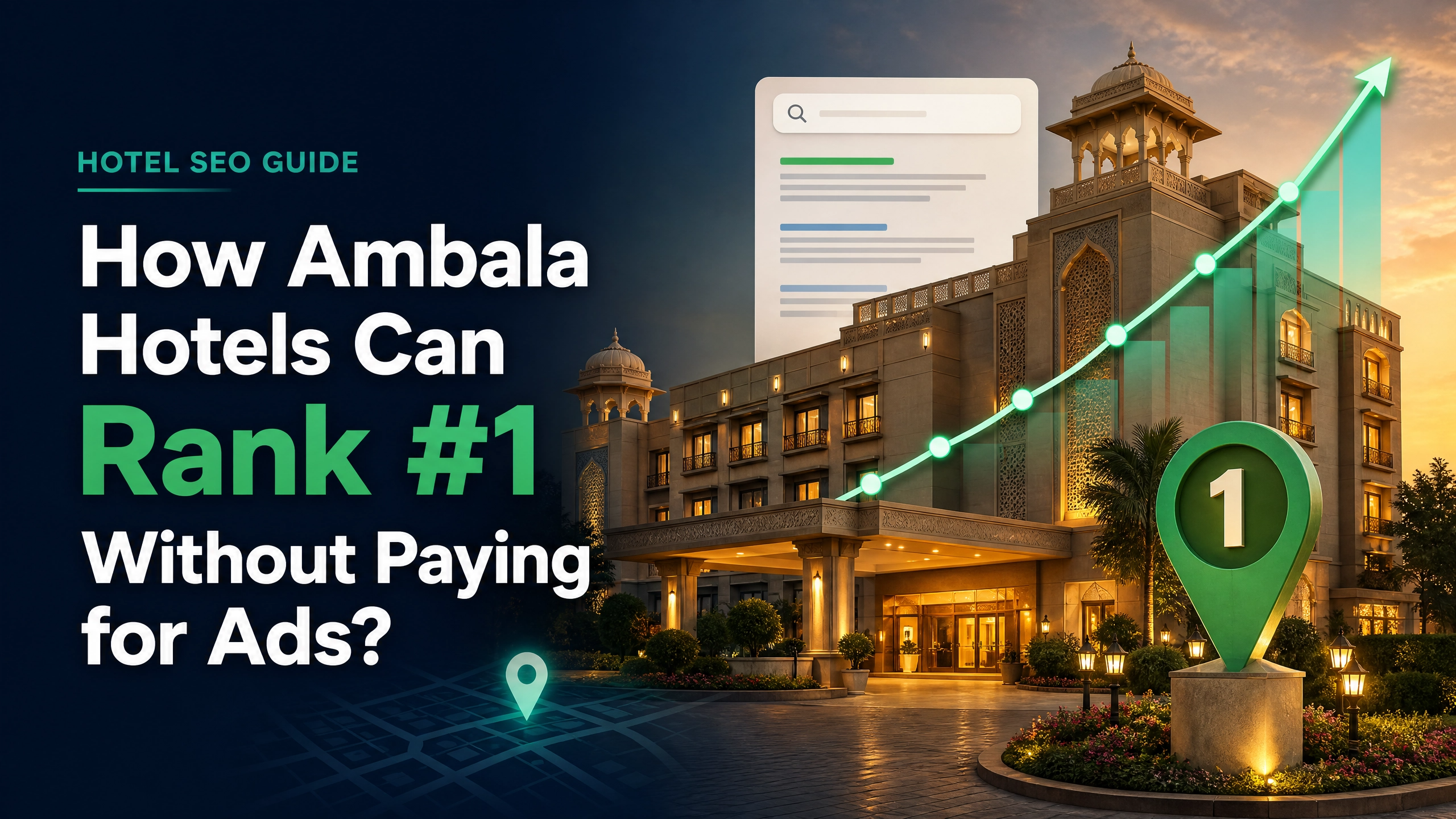
Kabir runs a 24-room hotel near Ambala Cantt railway station. Clean rooms, a rooftop that guests love, staff who remember returning customers by name. The kind of place that earns five stars when someone actually books it.
The problem is fewer and fewer people are booking it directly.
Three years ago, half his rooms filled through walk-ins and word of mouth. Today, almost every guest finds him through Booking.com or MakeMyTrip, and 18 to 20 percent of every tariff disappears into commission before he’s even changed the bedsheets. Meanwhile, a newer property two streets away, smaller and less impressive, shows up first when someone searches “hotels near Ambala Cantt railway station.” Kabir has the better hotel. The other owner has the better search visibility. Guests never get to compare the two, because they never make it to Kabir’s website in the first place.
Here’s what it actually takes for hotel SEO in Ambala to work, how to get SEO for hotels in Ambala ranking without touching a Google Ads account, and why most hotel owners are sitting on visibility they’ve never bothered to claim.
Why Is Every Hotel in Ambala Showing Up on Google Except Yours?
Think about the last time you booked a hotel in a city you’d never visited. Did you drive around looking for a signboard? No. You searched “hotels in Ambala” or “hotels near me Ambala,” scrolled through a handful of results, checked the star rating and a few reviews, and picked one, often before you ever opened an OTA app.
That search happens thousands of times a month for Ambala alone. People type “best hotels in Ambala,” “affordable hotels in Ambala,” “luxury hotels in Ambala,” “hotels near Ambala railway station,” or simply “rooms in Ambala hotels” from a bus seat or a train berth an hour before arrival.
Every one of those searches is a guest who hasn’t picked a hotel yet. If your property doesn’t appear in that moment, on Google Maps, in the local pack, or in the organic results underneath it, you don’t lose the booking to a better hotel. You lose it to whichever hotel Google decided to trust more.
That trust isn’t random. Google ranks hotels the same way it ranks restaurants and retail shops: relevance to the search, distance from the searcher, and how established and complete the listing looks. Hotels that treat their online presence like an afterthought lose that ranking to hotels that treat it like part of the front desk.
What Does Ranking #1 Actually Mean for a Hotel Business?
“Rank #1” sounds like a vanity metric until you realize what it’s actually worth. A hotel that ranks #1 for “hotels near Ambala Cantt” isn’t winning a trophy. It’s winning the booking before a guest even opens Booking.com, before any commission gets deducted, before any ad spend gets involved.
There are really three places a hotel needs to rank, and most owners only think about one of them:
- The Google Local Pack: the three map-pin listings that appear above every organic result when someone searches “hotels near me Ambala” or “hotels near Ambala Cantt.”
- Organic search results: the blue links below the map, where a hotel’s own website competes against OTA listing pages for broader searches like “best hotels in Ambala” or “book hotels in Ambala.”
- Google Hotel Search / Hotel Ads-free listings: the price comparison box that appears for hotel-specific searches, pulling directly from your Google Business Profile.
Ranking #1 across these three spots means a guest can find you, trust you, and book you directly, without ever handing 18 to 20 percent of your revenue to an intermediary. That’s the entire economic case for properly done hotel digital marketing in Ambala.
How Do Ambala Hotels Actually Rank #1 Without Spending on Ads?
This is where most hotel owners expect a complicated answer. It isn’t one big tactic. It’s five smaller, connected habits. Skip one, and the rest work at half strength.
1. Claim and fully build out your Google Business Profile
If you do only one thing after reading this, do this. A complete, correctly categorised Google Business Profile is the single strongest free lever a hotel has for local SEO for hotels in Ambala.
That means the right primary category (“Hotel,” not “Lodge” if you’re not one), your exact address matching Google Maps, real photos of rooms and the property instead of stock images, accurate check-in and check-out times, amenities ticked correctly, and a phone number that actually gets answered. A 24-room independent hotel with a properly completed profile can genuinely outrank a bigger, older property that never claimed theirs. Google doesn’t rank by room count. It ranks by relevance and completeness.
Most hotels in Ambala Cantt and Ambala City either haven’t claimed their listing at all, or claimed it once in 2019 and never touched it again. That gap is often the entire difference between two similar hotels on the same road.
2. Turn every satisfied guest into a review, on purpose
A traveler comparing two unfamiliar hotels in Ambala almost always picks the one with more reviews and a higher rating. This isn’t a guess; it’s the strongest trust signal in the entire hospitality search funnel, ahead of a polished website or even the room photos.
Most hotels wait for reviews to happen. The hotels that actually pull ahead ask for them, every single time, with a simple WhatsApp message sent at checkout: “Thanks for staying with us, would you mind leaving us a quick Google review?” We’ve seen this same structured-asking habit reshape a business’s entire online trust profile in our piece on marketing automations every growing business needs, where a consistent review system took a business from a handful of reviews to dozens within a few months. A hotel with 180 reviews at 4.5 stars beats a hotel with 12 reviews at 4.9 stars almost every time. Volume signals trust as much as the rating itself.
3. Build a website that answers a traveler’s questions before they call
Guests searching “hotels near Ambala railway station” or “hotels near Ambala Cantt” want three things fast: how far you actually are, what a room costs, and whether you have availability. A hotel website that buries this under a slow homepage and no pricing loses the guest to whichever OTA page answers it in three seconds.
A proper hotel website needs real-time or clearly stated room rates, a location that states distance from the railway station, Cantt, or G.T. Road landmarks, a simple enquiry or WhatsApp-to-book button, and fast load times on mobile, since most of this searching happens on a phone in a moving vehicle. This is the same lead-capture logic we cover in our guide on website features that actually generate leads, just applied to a traveler instead of a B2B buyer.
4. Publish the content travelers are already searching for
Every hotel gets asked the same handful of questions on repeat. What’s nearby to eat? How far is the Cantt from the City side? Is there parking for a car or a family travelling by road? A few honest, well-written pages or blog posts answering these questions do two jobs at once. They give Google something concrete to rank for hyper-local, long-tail searches, and they give a hesitant traveler enough confidence to book without calling first.
This is the same content principle behind everything we build for local businesses: answer the real question before the visitor has to ask it. We’ve written about this approach in more depth in our guide on the warning signs a business needs a digital transformation, where a flat lead count almost always traces back to a website that answers nothing a visitor is actually searching for.
5. Get listed everywhere, consistently, not just on Google
Search engines and travelers both check your details in more than one place: Google, Justdial, TripAdvisor, Facebook, and wedding or event planning directories if you host functions. If your hotel’s name, address, or phone number is even slightly different across these- a missing floor number, an old phone line, “Hotel” versus “The Hotel,” it quietly damages how much Google trusts your listing. Getting these consistent is unglamorous work, but it’s one of the most overlooked pieces of hotel SEO services in Ambala and one of the cheapest to fix.
Are OTAs Actually Helping Your Hotel, or Quietly Replacing It?
OTAs aren’t the enemy here. They bring genuine bookings, especially from outside Ambala. The problem starts when an OTA becomes the only way guests find you. At that point, you’re not running a hotel with an OTA listing. You’re running a hotel that exists because an OTA lets it.
Every booking that comes through an OTA instead of your own site costs you a commission that ranking organically would have kept in your pocket. A hotel earning ₹2,500 a night loses roughly ₹450 to ₹500 per booking to commission alone. Multiply that by a few hundred bookings a year, and it’s not a rounding error. It’s real, recurring revenue that a stronger direct search presence quietly returns to you.
The goal isn’t to abandon OTAs. It’s to make sure your own name, your own Google listing, and your own website are strong enough that guests who’ve already stayed with you, or found you through search, book you directly the second time.
What Does a Realistic Hotel SEO Timeline Look Like in Ambala?
Hotel owners usually ask one question after hearing all this: how long before it actually moves the needle? Here’s a fair, honest breakdown.
| Channel | Best For | Effort Needed | Cost | Booking Impact |
|---|---|---|---|---|
| Google Business Profile | “Near me” and Cantt/City-specific searches | Low, once set up properly | Free | Very High |
| Guest Reviews | Trust before first-time booking | Low, ask at every checkout | Free | Very High |
| Hotel Website | Direct bookings, rate clarity, SEO base | Medium, one-time build | ₹15,000 to ₹40,000 | High, compounds over time |
| Local/Landmark Content | Long-tail searches (railway station, Cantt, market areas) | Medium, ongoing | Low | Medium to High |
| Listing Consistency (NAP) | Trust signal across platforms | Low, one-time cleanup | Free | Medium |
Google Business Profile improvements can show visible movement within 2 to 4 weeks. Reviews build steadily with a consistent ask. A proper website with local SEO usually takes two to four months to fully compound into a reliable stream of direct enquiries, slower than an ad campaign, but the traffic doesn’t disappear the moment you stop paying for it.
GrowNerds Solution: A Digital Growth Ecosystem for Ambala Hotels
Most hotels in Ambala have tried a fragment of this. A Google listing set up once, in 2020, and never touched since. A website built by a nephew’s friend that hasn’t been updated in three years. A WhatsApp number nobody checks after 9 p.m., right when a train-side traveler is deciding where to stay tonight.
The problem is never one missing piece. It’s that none of the pieces are connected. At GrowNerds, we don’t sell hotels a single service. We build a complete digital growth ecosystem:
- A Google Business Profile fully optimized for your category, exact locality (Cantt, City, near the railway station, or G.T. Road), and amenities, built to win the local pack.
- A fast, mobile-first hotel website with clear rates, real photos, and a direct WhatsApp-to-book flow that reduces dependency on OTA commissions.
- A structured, consistent review-ask system that grows your rating and review count month over month, not in random bursts.
- Local content built around the exact questions travelers search before booking a hotel in Ambala: distance from the station, nearby markets, parking, and family or business traveler needs.
- Listing consistency across Google, Justdial, and other directories so every platform agrees on who you are.
Before and After: What Changes for a Hotel in Ambala
| Area | Without a Digital Presence | With a Digital Growth Ecosystem |
|---|---|---|
| Discovery | Relies almost entirely on OTAs and walk-ins | Shows up directly in the local map pack for “hotels near me” searches |
| Guest trust | Few reviews, inconsistent listing details | Growing reviews, complete profile, consistent details everywhere |
| Booking cost | 18 to 20% lost to OTA commission on most bookings | Higher share of direct, commission-free bookings |
| Guest inquiries | Missed calls, unanswered late-night WhatsApp messages | Fast replies, WhatsApp-to-book, fewer lost enquiries |
| Long-term visibility | Flat, dependent entirely on third-party platforms | Steady, compounding organic growth that doesn’t stop when spending stops |
The Bottom Line
Kabir isn’t losing bookings because his hotel isn’t good enough. He’s losing them because a traveler searching “hotels near Ambala Cantt railway station” never finds him before finding someone else, and by the time that traveler lands on an OTA app, the commission conversation is already over.
Hotel SEO in Ambala doesn’t need an ad budget to work. It needs a claimed and complete Google Business Profile, a habit of asking every guest for a review, a website that answers a traveler’s real questions in the first ten seconds, and consistent details across every platform a guest might check. None of it is complicated. Almost none of it costs money. It just needs to be done properly, and kept up.
Every hotel in Ambala, from the ones lining G.T. Road to the properties tucked into Sadar Bazar and Cantt, is competing on this exact same ground now. The hotels ranking #1 aren’t always the biggest or the newest. They’re the ones a traveler can actually find.
Frequently Asked Questions
Do small, independent hotels in Ambala really need SEO?
Yes, arguably more than larger chains. Most travelers now search Google before opening any OTA app. A hotel with an incomplete or unclaimed Google listing loses those searches to a smaller competitor who simply set their profile up correctly.
Where should a hotel in Ambala start with SEO?
Start with a fully completed Google Business Profile and a consistent habit of asking every guest for a review at checkout. Both are free, take a short time to set up properly, and produce the fastest visible movement in local search.
Can a hotel really reduce its OTA dependency through SEO alone?
Not entirely, and it shouldn’t try to. OTAs bring real bookings, especially from outside Ambala. What SEO does is grow the share of guests who find and book you directly, which lowers the average commission cost across your total bookings over time.
How much does hotel SEO in Ambala typically cost?
A Google Business Profile and a review-ask habit cost nothing but consistency. A proper hotel website with local SEO built in typically runs ₹15,000 to ₹40,000 as a one-time build, a fraction of what OTA commissions quietly cost across a single year.
How long before a hotel sees more direct bookings from SEO?
Google Business Profile improvements can show movement within two to four weeks. Reviews build steadily with consistent asking. A website with proper local SEO usually takes two to four months to fully compound into a reliable stream of direct booking enquiries.
Is hiring a hotel SEO agency in India worth it for a small property?
It depends on whether the agency understands hospitality search behavior specifically, since hotels rank on different signals than a retail shop or a service business. A hotel marketing agency in Ambala that treats SEO, reviews, and the website as one connected system tends to outperform a single freelance service handling each piece in isolation.
A digital strategist building scalable ecosystems for many kinds of businesses. Focused on turning online presence into structured, revenue-driven growth systems. As a researcher, Nishant has done a lot of experiments, and through learning from them, he now founded GrowNerds so that he could provide a scalable digital ecosystem to every type of business.
Leave a Reply