Ramesh ji makes precision lab instruments in Ambala. His products are solid, pricing is fair, and export paperwork is clean.
But last month, a German buyer found his competitor first. Not because the competitor’s product was better. Because the competitor’s website loaded in 2 seconds and had a “Request a Quote” button. Ramesh ji’s website took 9 seconds to load. And it only had a phone number from 2014.
That’s the gap in 2026. Not product quality. Website quality.
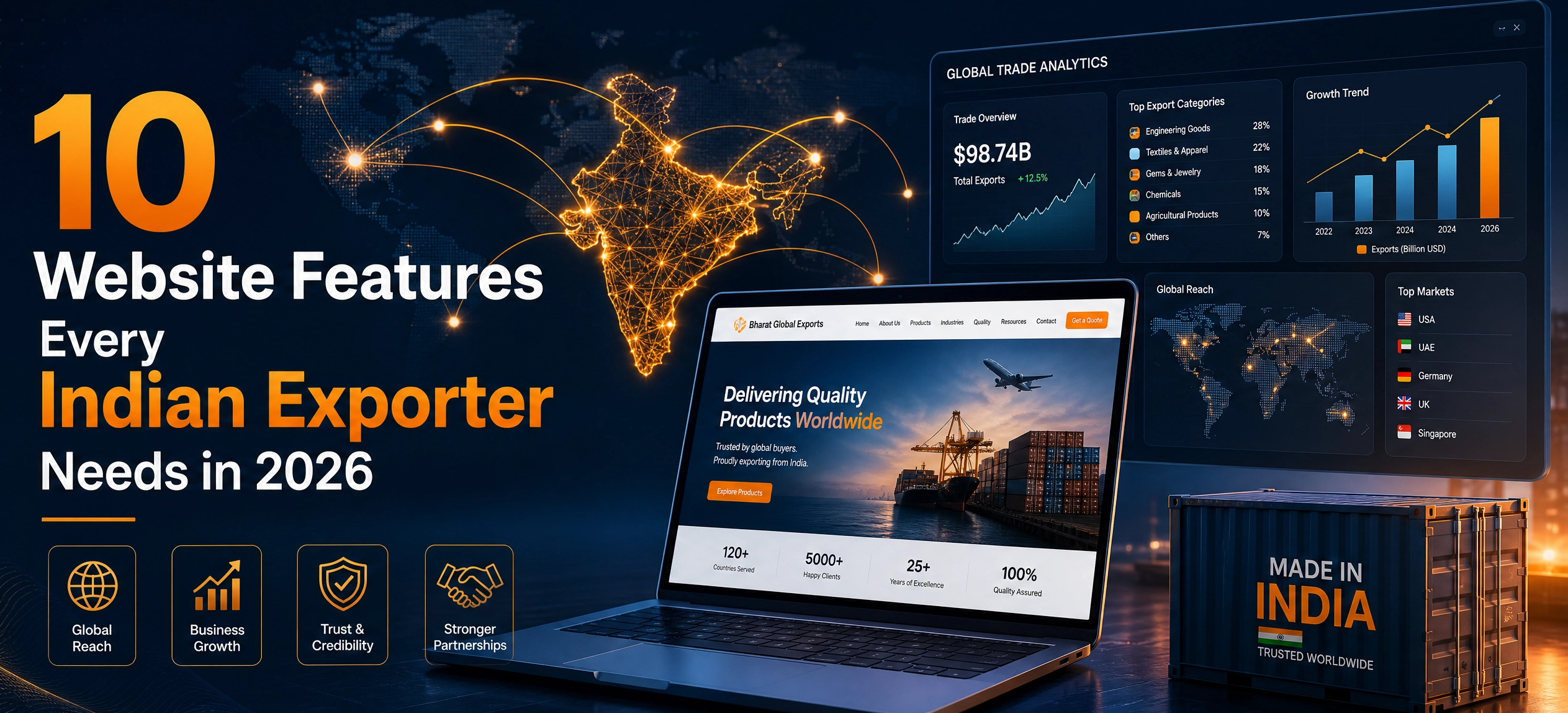
Below are the 10 features every Indian exporter’s website needs this year. Miss even one, and the buyer moves to the next tab; straight to your competitor.
Why This List Matters Now
Buyers don’t wait anymore. They check your site, decide in under 30 seconds, and move on. No second chances.
International buyers today behave differently than they did five years ago:
- They browse on mobile, often between meetings or time zones.
- They compare 3-4 suppliers in one sitting, side by side.
- They expect an instant response, not a “we’ll get back to you in 3 days.”
- They Google specific product specs, not just company names.
- They increasingly ask AI tools like ChatGPT to shortlist suppliers before they ever visit a website.
IndiaMART is still useful. But it puts you next to 50 competitors on the same page, all bidding for the same buyer’s attention. Your own website puts you next to nobody. That’s the real difference between a lead and a direct customer, and it’s the difference between renting your buyer relationships and owning them.
Let’s get into the 10 features, one at a time.
1. A “Request a Quote” Button: Not Just “Contact Us”
Buyers don’t want to write an email essay explaining what they need. They want to pick a product, hit one button, and send basic details in under a minute.
What this button needs to do well:
- Sit visibly on every single product page, not just the homepage
- Ask for only the essentials: product, quantity, destination country
- Send an instant confirmation so the buyer knows their inquiry landed
- Route directly to a person on your team, not a shared inbox nobody checks
A generic “Contact Us” page buried in the footer does not convert. A visible, low-friction quote button does.
2. Product Pages With Real Specs: Not Just a PDF
A PDF catalog is invisible to Google. It cannot be indexed, searched, or found by a buyer typing a specific spec into a search bar. A product page with specs, images, and HS codes gets found on Google directly.
Each product page should include:
- Full technical specifications in a scannable format.
- Multiple product images, including packaging and labeling.
- HS code and relevant export documentation details.
- Certifications specific to that product, not just the company.
Buyers today Google the exact spec they need: “digital pH meter 0.01 accuracy export India,” for example. If your product isn’t a page, it simply does not exist for that search.
3. Trust Badges Above the Fold
ISO certification. CE marking. Export awards. Years in business. These need to sit near the top of your homepage, not hidden on an “About Us” page nobody visits.
Trust signals that matter most to international buyers:
- Recognized certifications (ISO, CE, BIS, or industry-specific marks).
- Years of export experience, stated as a specific number.
- Countries you’ve already shipped to, listed by name.
- Any recognitions, awards, or association memberships.
Buyers scan for trust signals in the first 5 seconds. If they don’t see proof quickly, they assume you don’t have it.
4. WhatsApp Business Chat Widget
International buyers are used to instant replies. A WhatsApp widget with a quick auto-response bridges the time zone gap while your team is asleep.
A well-set-up WhatsApp widget should:
- Appear on every page, not just the contact page.
- Send an automatic first reply confirming the message was received.
- Route to whichever team member is actually online.
- Save every conversation so nothing gets lost in personal chats.
This single feature converts more browsers into leads than any contact form, because it matches how buyers already communicate every day.
5. Case Studies With Buyer Countries Named
“We export quality products” means nothing. “We shipped 200 units to a lab in Germany last quarter” means everything. Specific, named, and real.
A strong case study includes:
- The buyer’s country and industry (without breaching confidentiality).
- The specific problem they came to you with.
- What you delivered, and any numbers that show scale.
- A short quote or outcome, if the buyer is willing to share one.
This is the single biggest trust-builder on an exporter website, because it proves you’ve already done what the new buyer is considering doing.
6. Mobile-First, Fast-Loading Design
Most international buyers are checking your site from a phone, often on the move, between calls, or late at night in their own time zone. If your site takes more than 3 seconds to load, they’re gone before they’ve even seen your product range.
What mobile-first design actually requires:
- Compressed images that load fast without losing quality.
- Buttons and forms that are easy to tap on a small screen.
- No pop-ups that block the screen on mobile.
- A layout that reads clean without pinch-zooming.
Speed isn’t a nice-to-have anymore. It’s the entry ticket to even being considered.
7. A Clear “Why India / Why Us” Section
Buyers comparing you to suppliers in Vietnam, China, or another Indian exporter need a reason to pick you specifically. Don’t make them guess.
This section should spell out, clearly and briefly:
- Quality certifications that set you apart.
- Typical turnaround and shipping timelines.
- Pricing transparency, or how quotes are structured.
- Any specialization that makes you the better fit for their exact need.
A vague “we are committed to quality” paragraph doesn’t do this job. Specific, comparable facts do.
8. Auto-Responder for After-Hours Inquiries
A buyer in the US is awake when your team is asleep in India. An auto-response that confirms “we received your inquiry, response in X hours” keeps them from moving to a competitor while you sleep.
This should include:
- An immediate acknowledgment the moment a form or WhatsApp message comes in.
- A realistic response time, so the buyer isn’t left guessing.
- A fallback contact (email or WhatsApp) for urgent inquiries.
- Time zone awareness built into your response commitment.
Buyers don’t expect you to be awake 24/7. They just expect to know they’ve been heard.
9. SEO-Optimized Content: Built for Google AND AI Search
In 2026, buyers also ask ChatGPT and Google’s AI Overview to find suppliers before they ever type a search query themselves. If your site isn’t structured with clear headings, FAQs, and schema markup, AI tools skip you entirely.
What this looks like in practice:
- Clear H2/H3 headings that answer specific buyer questions.
- FAQ sections with schema markup, so AI tools can extract answers directly.
- Product pages with structured data, not just images and prose.
- Internal linking between related products and services.
This is no longer optional. It’s the difference between being recommended by AI search and being invisible to it.
10. A Lead Capture System That Doesn’t Depend on IndiaMART
This is the big one. Your own website should be capturing leads directly, not routing every inquiry through a third-party marketplace where you’re one of fifty listings on the same page.
A strong, independent lead capture system includes:
- Forms and WhatsApp integration that feed directly into your own CRM or sheet.
- No marketplace commission or dependency on someone else’s algorithm.
- Full ownership of buyer contact details from the first inquiry.
- The ability to run your own follow-up sequences on your own timeline.
Own your leads. Own your buyer relationships. That’s the entire point of having a website in the first place.
The Real Cost of Skipping These
Every week without these features is a buyer who found your competitor first. Not because they build better products. Because their website did the job while yours sat idle.
If any of this sounds familiar, it’s worth checking the broader picture too. We’ve covered this in detail in 8 Signs Your Business Needs a Digital Transformation; an outdated, slow, or invisible website is usually just the first symptom, not the only one.
How GrowNerds Builds This Ecosystem for Real Businesses
Most agencies sell a website and disappear. GrowNerds builds what we call a digital growth ecosystem, where the website, the outreach, and the lead follow-up all work together, instead of sitting as separate, disconnected pieces.
Here’s what that looks like in practice for exporters and manufacturers we work with:
Website as the foundation:
We build export-ready websites with the exact features covered in this blog: quote buttons, product pages, trust badges, and mobile-first speed. So the site itself starts converting from day one.
Direct outreach that drives traffic to that website:
Through WhatsApp and LinkedIn outreach, we bring manufacturers in Ambala and exporters across Delhi NCR directly in front of international buyers, instead of waiting for buyers to stumble onto a marketplace listing.
Lead capture that feeds a real system:
Every inquiry, whether it comes from WhatsApp, the website form, or a LinkedIn message, lands in one place your team can act on, instead of getting lost across five different inboxes.
Follow-up sequences that don’t let leads go cold:
Most exporters lose deals not from a lack of interest, but from slow or missing follow-up. We build automated nurturing sequences so no inquiry sits untouched for days.
SEO and AI search visibility, built in from the start:
Every website and blog we build is structured for both Google and AI search tools, so manufacturers show up where buyers are actually looking in 2026, not just on a marketplace page.
The result, in the real world, is straightforward: businesses that were fully dependent on IndiaMART start generating direct inquiries from their own website within weeks — inquiries that don’t cost a commission and don’t disappear into a shared listing page. Scientific instrument makers in Ambala, and exporters across Delhi NCR, have used exactly this ecosystem to move from marketplace dependency to owning their own buyer pipeline.
That’s the difference between a website that exists and a website that’s part of a working growth system.
FAQs
Q1: Do I really need a website if I’m already active on IndiaMART?
Yes. IndiaMART puts you next to competitors on the same page. Your own website is where serious buyers verify you’re legitimate before placing a large order.
Q2: How much does a 2026-ready exporter website cost?
It depends on scope, but the ROI comes from direct leads that don’t need a commission cut, unlike marketplace-driven inquiries.
Q3: Will a WhatsApp widget really increase leads?
Yes. International buyers expect instant response. A WhatsApp widget with auto-reply captures interest before it cools off.
Q4: What’s the fastest feature to add first?
Start with a “Request a Quote” button and a WhatsApp widget. Both are quick to implement and immediately reduce friction for buyers.
Q5: How does AI search change exporter SEO?
Buyers now ask AI tools like ChatGPT to find suppliers. Structured content with clear headings and FAQs gets picked up by AI search; unstructured PDFs don’t.
Q6: How is GrowNerds different from a regular web design agency?
GrowNerds doesn’t stop at building the website. We connect it to outreach, lead capture, and follow-up systems, so the website becomes part of a working growth ecosystem instead of a standalone brochure.
A digital strategist building scalable ecosystems for many kinds of businesses. Focused on turning online presence into structured, revenue-driven growth systems. As a researcher, Nishant has done a lot of experiments, and through learning from them, he now founded GrowNerds so that he could provide a scalable digital ecosystem to every type of business.
Leave a Reply