Two businesses go live at the same time. Both have a solid website, both run ads, and both expect growth. Six months later, the numbers split.
One is still paying for attention—traffic comes and goes, leads stay inconsistent, and revenue follows spend. The other starts seeing compounding results—organic traffic builds, leads stack, and conversion improves without increasing budget.
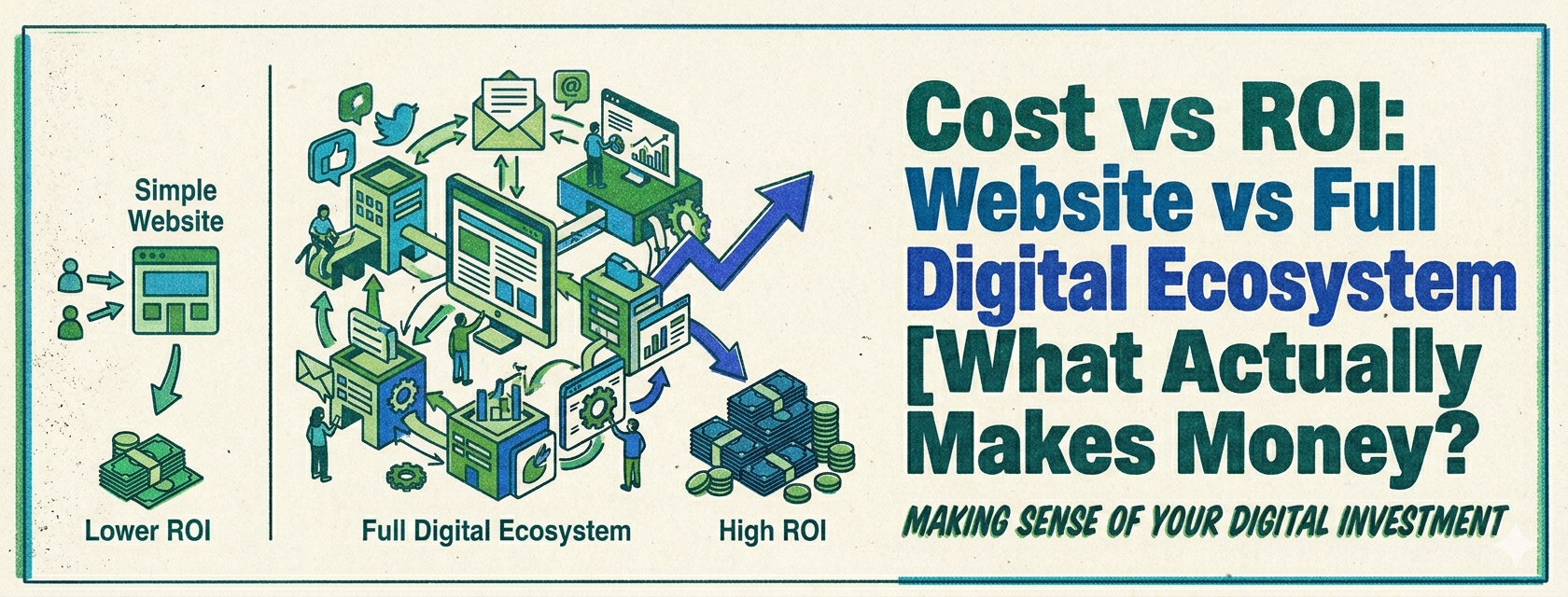
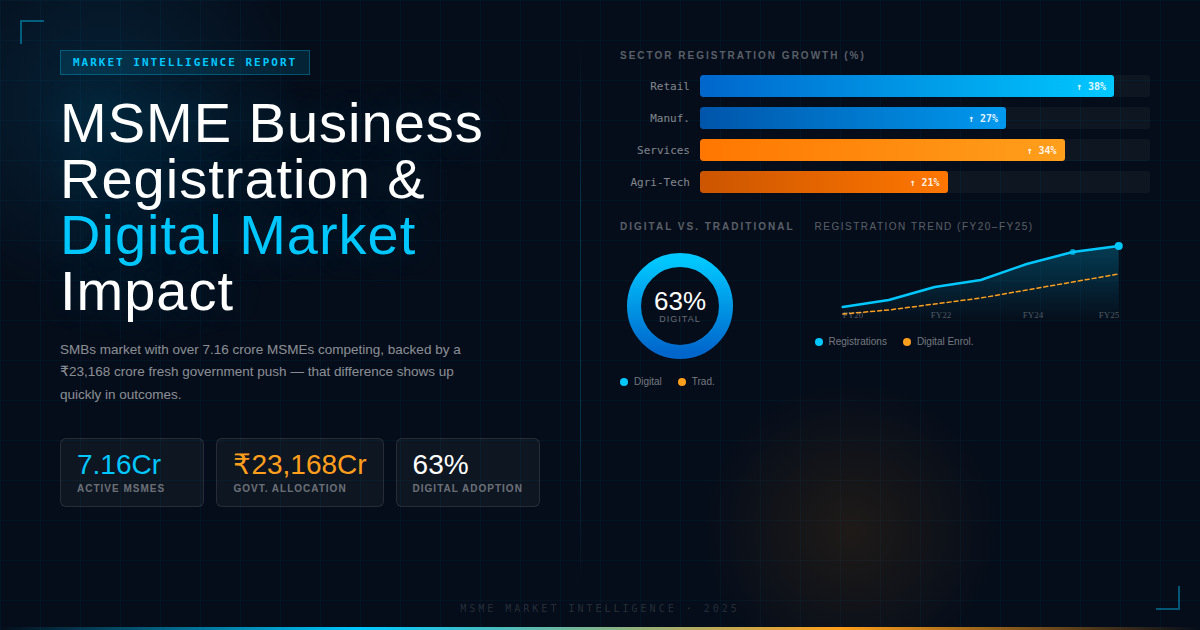
That gap comes down to the digital ecosystem vs website. A website is static. A digital growth ecosystem compounds. And in a market with over 7.16 crore MSMEs competing, backed by a ₹23,168 crore fresh government push, that difference shows up quickly in outcomes.
A business website vs digital ecosystem isn’t just a setup choice—it’s a revenue decision. One keeps you visible. The other builds a system that drives consistent returns. That’s where the real shift happens: the ROI of digital marketing systems, not just having an online presence.
Let’s find which one is a better decision for your business and get insights for:
- Working comparison
- Cost comparison
- ROI comparison
- Real business comparison
Website vs Digital Ecosystem: What’s the Difference?
At first, we will walk you through what a website and a digital ecosystem actually do when applied to any business.
What Website Actually Does?
A website is where people land after they’ve already heard about you. It holds your story. Your product. Your positioning.
- It can build some level of brand authority if done well. But on its own, it doesn’t create demand.
- Most founders quietly know this. You launch a site. Then you start asking: “How do we get people here?”
- Without distribution, your website depends on outside effort—ads, outreach, referrals. It doesn’t generate momentum by itself.
And that’s why SEO and content marketing ROI feels low for many teams. Because the website isn’t connected to a broader system. It’s just sitting there.
What Digital Ecosystem Actually Do?
A digital ecosystem for business growth is your blog, LinkedIn posts, email sequences, YouTube clips, SEO playbook, and, yes, the website too. All connected. All feeding each other. This means building multi-channel marketing systems for businesses.
Think in layers.
- Search brings intent.
- Content builds trust.
- Social creates visibility.
- Email and CRM close the loop.
Now your website isn’t the starting point; it’s part of a flow.
This is what a digital ecosystem for business growth actually looks like. Everything is connected. Everything compounds.
Cost Breakdown: Website vs Digital Ecosystem
The cost to create a full website or digital ecosystem depends on your business complexity and which features you want to include.
A business website can cost you around INR 80,000 for a small business to INR 500,000+ for an enterprise business.
On the other hand, a digital ecosystem is like an overall investment that also includes the core website of the business. The digital ecosystem investment ranges from INR 50,000 for a small business to INR 200,000+ for an enterprise. You can also select additional features to target your audience more efficiently.
An upfront cost can be lower, but real investment shows up in consistency over time. Let’s find out how.
Digital Ecosystem vs Website: Factors that Influence the Investment
There are a lot of small but impactful factors that affect the digital ecosystem cost for businesses. Here are a few of them.
Customer Journey Complexity
If your sale takes three demos, a security review, and approval from two departments? That’s a different game, and this is also one of the factors that impact the cost.
You need a multi-channel marketing system that nurtures over weeks. Emails after the first call. Case studies after the second. An ROI calculator before the third.
The website is just the handshake. The ecosystem is the conversation.
Brand Authority Requirements
If you’re selling to an enterprise, your website matters less than the fact that you’ve been quoted in three industry newsletters. Or that your CEO speaks at the right conferences. Or that your name keeps showing up in their Slack channels.
That’s brand authority. And you can’t fake it with a pretty homepage.
A digital growth strategy means showing up consistently across places you don’t control. LinkedIn. Podcasts. Communities. Even Reddit.
Traffic vs. Dependency
Most websites are dependent assets. No traffic unless you push it with backlinks or ads. It never really stops.
A multi-channel marketing system changes that. Now you’re building organic traffic through content, search, and distribution. That’s when growth starts compounding instead of resetting every month.
Automation & Systems
A lot of websites just collect leads. Then nothing happens. No follow-up, no structure, no system.
A real digital ecosystem runs on CRM systems that track where someone is in the customer journey. Blog read? Send the explainer video. Whitepaper download? Route to sales. Pricing page visited three times? Trigger a special offer.
Internal Capability vs External Support
Execution is where most strategies die. Not because they’re wrong, but because teams can’t keep up. Content, SEO, systems—it’s ongoing work. Not a one-time setup.
So you either build internally or plug in external support. Either way, the investment isn’t just money. It’s an operational commitment.
ROI Comparison: Which One Actually Makes Money?
This section is all about the return on investment comparison between just a website for your business and a digital ecosystem.
ROI of a Website
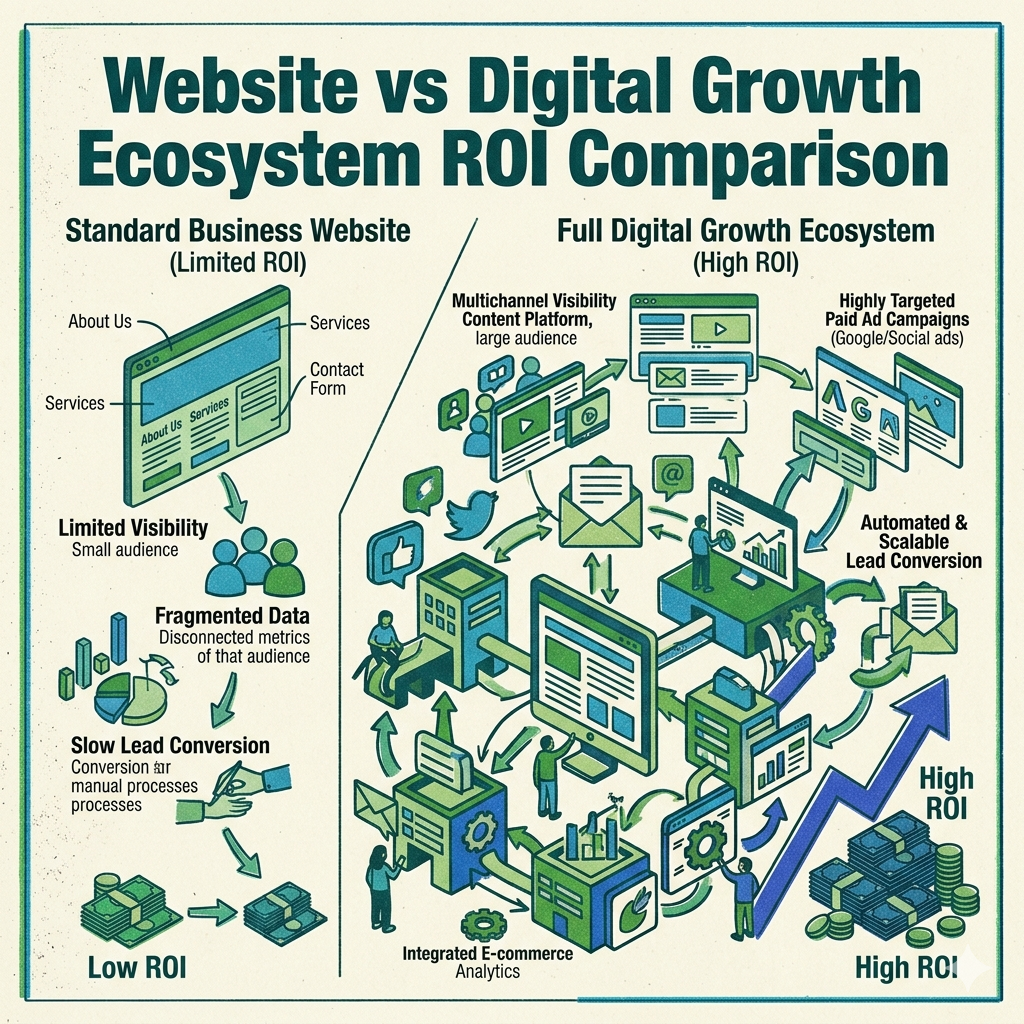
A website can look great and still do nothing for the business.
It sits there. Holds information. Builds some credibility. But it rarely drives consistent outcomes on its own.
So ROI depends on what you bolt on—ads, outbound, partnerships. Which means you’re constantly feeding it to get results.
The website didn’t create demand. It just caught what was already falling.
ROI of a Digital Ecosystem
A digital ecosystem connects traffic, trust, and conversion. Content brings people in. Distribution keeps it moving. Systems close the loop.
This is where business automation systems start to matter. Leads don’t just come in—they get tracked, nurtured, and converted.
The website didn’t change. The sales funnel didn’t change. The ecosystem kept producing.
Over time, your digital growth strategy starts lowering your cost per lead. And that’s when things flip.
You’re not chasing revenue anymore. The system is producing it.
How a Digital Ecosystem Generates Consistent Revenue
Every founder and owner of the business wants to know how a digital ecosystem can generate consistent revenue. What does it feature more of? Does it nurture all leads, one at a time? Let’s find all the answers below.
Traffic Layer (SEO, content, social visibility)
Traffic isn’t the hard part anymore. Consistency is key.
Anyone can run ads or post content for a week. Very few build something that compounds. That’s where organic traffic quietly wins.
When you create a complete digital growth system, your online presence stops depending on spikes. SEO brings intent. Content strategy builds depth. Social visibility keeps you in the conversation.
Trust Layer (branding, authority, LinkedIn presence)
Traffic without trust is just noise. People land on your site. They scroll. They leave. Why? Because you look like everyone else.
Brand authority is the difference between a bounce and a lead. And in B2B, especially, your online presence matters more than your pitch deck.
Your LinkedIn presence, your positioning, and your voice—all of it shapes how quickly someone moves through the customer journey.
When done right, people already trust you before the first call. That shortens sales cycles more than any tactic.
Conversion Layer (landing pages, CTAs, funnels)
They drive traffic to a homepage. Or a “contact us” page. That’s like opening a store with no cash register.
You need a real conversion funnel. Landing pages that speak to one problem. One clear CTA.
Good landing pages don’t try to impress. They remove friction. When this layer works, your existing traffic becomes more valuable overnight. No extra spend. Just better flow from interest to action.
Automation Layer (CRM, email, WhatsApp, chatbots)
This is where revenue gets predictable. You capture a lead. Then what? If you reply in 3 days, you’ve lost them.
CRM systems keep your pipeline clean. Lead nurturing keeps conversations alive. Email, WhatsApp, chatbots — they close the gaps humans forget.
When this layer is dialed in, revenue stops depending on memory or effort. It becomes process-driven.
Real-World Scenario: Cost vs Outcome
We have made a business comparison, where business A has a core website and business B has a digital ecosystem. Let’s compare both.
Build a Digital Ecosystem That Actually Generates ROI with GrowNerds
In the end, this isn’t about choosing better design or better tools. It’s about choosing how your business grows. A website can support you. A system can scale you.
That’s where digital ecosystem services start to matter. At GrowNerds, the focus isn’t just building assets—it’s helping businesses.
Create a complete digital growth system that actually drives outcomes. Traffic that compounds, not spikes. Leads that convert, not just collect. Systems that follow up, not forget.
The difference shows up in quieter ways: lower acquisition costs, shorter sales cycles, stronger brand pull, and revenue that doesn’t reset every month.
If growth needs to feel more predictable than experimental, it might be time to look beyond just having a website.
FAQs
Is a website enough for business growth?
Not really. A website supports growth, but it rarely drives it on its own. It depends on ads, outreach, or referrals to bring traffic. Without a system behind it, results stay inconsistent and stop the moment effort stops.
What is a digital ecosystem in business?
A digital ecosystem is a connected system of channels and tools working together—SEO, content, social, funnels, and CRM. It guides the full customer journey from discovery to conversion and follow-up. Instead of isolated efforts, everything compounds and feeds into revenue.
How much does a digital ecosystem cost?
It depends on complexity but typically ranges from ₹50,000 to ₹200,000+ as an initial setup. The bigger factor isn’t just setup cost—it’s ongoing execution (content, SEO, systems). That’s where the real investment shows up.
Which has better ROI: website or marketing system?
A digital ecosystem consistently delivers better ROI. A website’s returns are limited and dependent on external effort. A system generates inbound demand, improves conversion, and lowers cost per lead over time—so returns compound instead of resetting.
How long does it take to see ROI?
Early signals can show in 6–8 weeks (traffic, engagement, initial leads). Meaningful ROI usually builds over 3–6 months as content, SEO, and systems start compounding. After that, results become more stable and predictable.
A digital strategist building scalable ecosystems for many kinds of businesses. Focused on turning online presence into structured, revenue-driven growth systems. As a researcher, Nishant has done a lot of experiments, and through learning from them, he now founded GrowNerds so that he could provide a scalable digital ecosystem to every type of business.
Leave a Reply