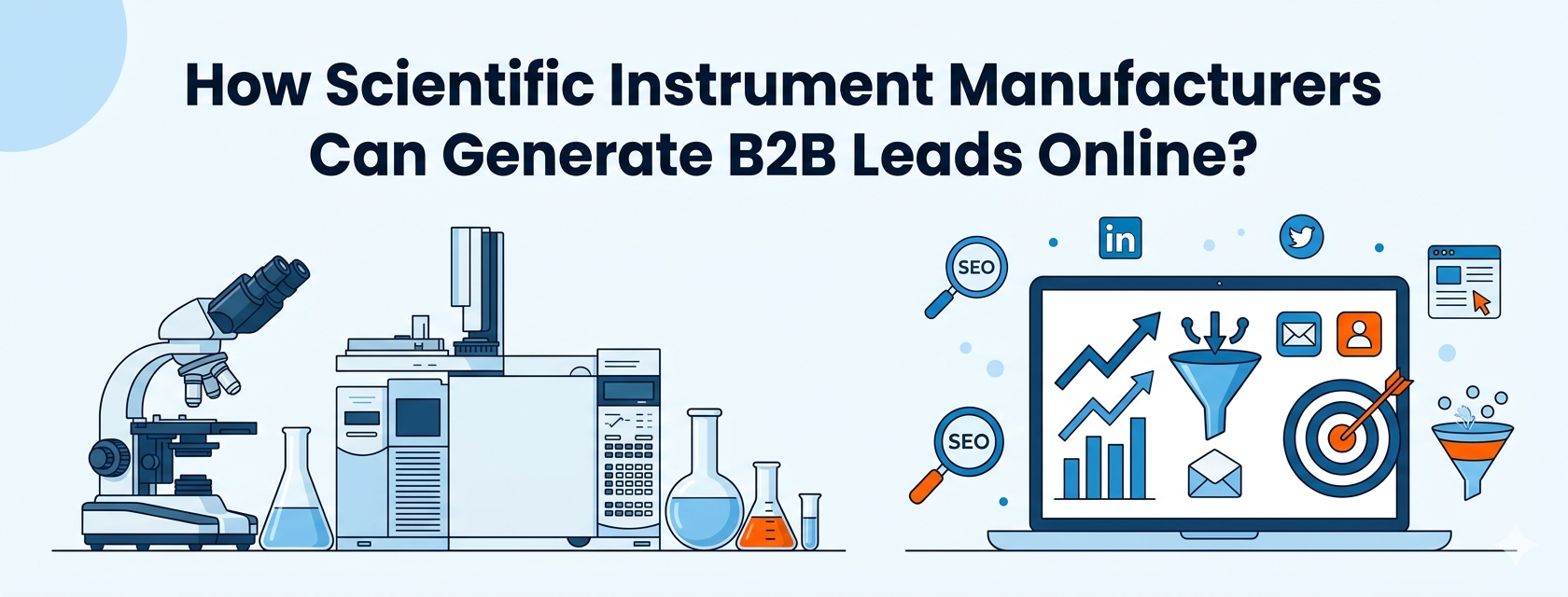
When a lab director starts searching for a new chromatography system, the conversation rarely begins with a sales call anymore—it starts online.
A late-night Google search, a comparison page opened between investor meetings, and a technical white paper shared in a procurement group chat. The internet is where buying journeys now take shape.
In an industry racing toward a $66.27 billion market by 2028, scientific instrument manufacturers can no longer rely on trade shows and distributor networks alone.
The real question is no longer whether digital matters, but how scientific instrument manufacturers can generate B2B leads online in a way that reaches researchers, procurement heads, and enterprise buyers before competitors do.
This article breaks down exactly how leading manufacturers can turn online visibility into a qualified pipeline and measurable growth.
3 Reasons Why Traditional Lead Generation Is No Longer Enough
Before moving any further, you should know why it’s important to adopt the new technology to find reliable clients.
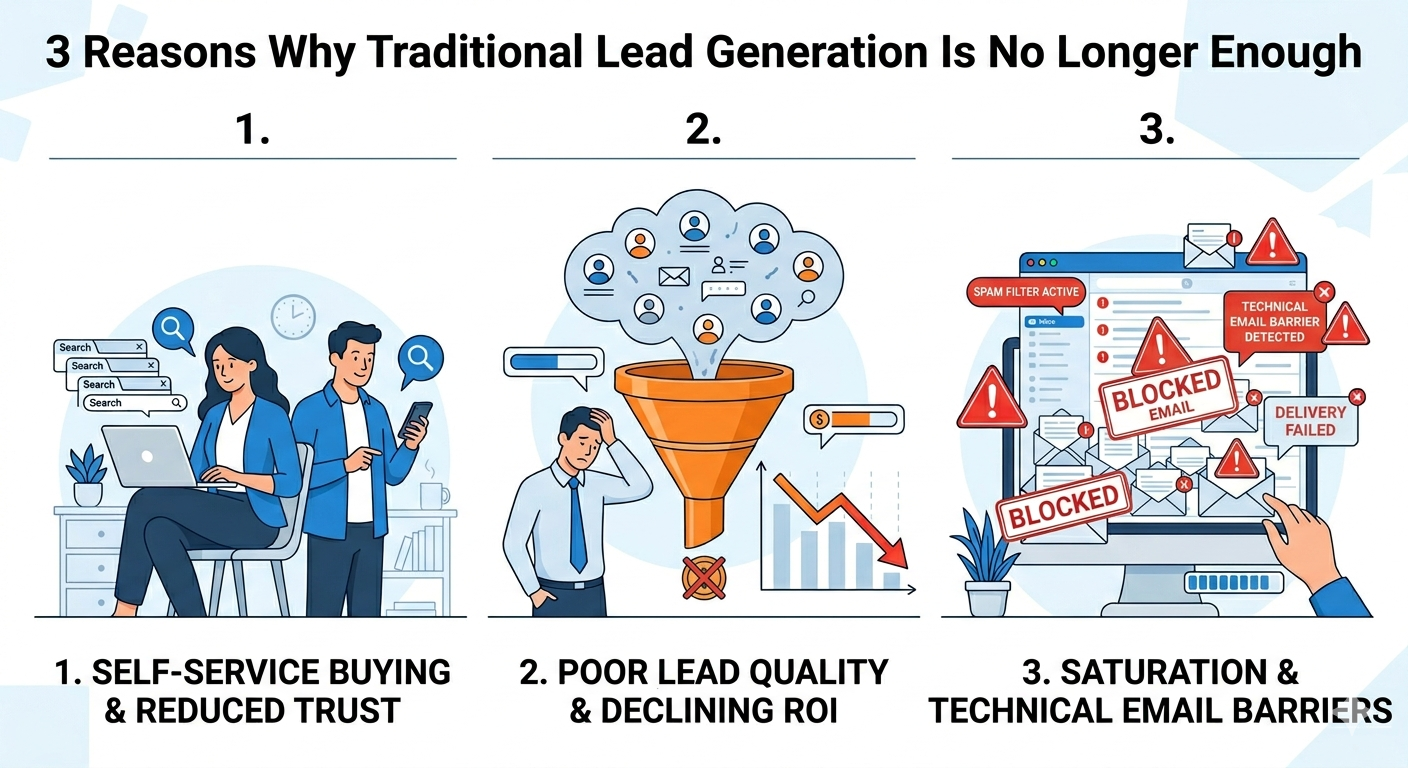
1. The Rise of Self-Service Buying & Reduced Trust
Buyers don’t need your cold email anymore. They already found you or someone like you on Google three weeks ago.
When a manufacturing plant needs custom laboratory equipment, the procurement manager isn’t sitting around waiting for your LinkedIn message. They’re already comparing three vendors. They’ve watched demo videos, read reviews, and seen case studies. The buying decision is 70% done before you even know they exist.
This changes everything about how you sell. Traditional lead generation assumes you’re introducing someone to your solution for the first time. The trust piece is brutal, too.
What actually works now is being visible when they’re already looking. That’s not lead generation; that’s presence. It’s SEO, it’s content, and it’s being in the right places when the buying committee is researching.
2. Poor Lead Quality and Declining ROI
Here’s the ugly truth: most lead lists are garbage. I’ve bought lists for online lead generation targeting manufacturers. The data is stale. Job titles are wrong. People have moved. Company sizes are inflated. You’re paying for contacts that stopped being relevant months ago.
For custom laboratory equipment manufacturers or scientific instrument makers, this is especially broken.
The other problem: quantity over quality. Marketing teams chase lead volume because it looks good on a dashboard.
It’s the wrong metric. You need leads that move, not leads that exist.
3. Saturation and Technical Email Barriers
Email as a channel is completely saturated. Everyone’s doing it. Sales development reps are working from the same playbooks. Founders are copying the same sequences. AI tools are generating mass personalization that feels like mass personalization.
On top of that, Gmail, Outlook, and corporate email filters are getting smarter.
And here’s what actually matters: when three different vendors are sending you nearly identical emails from slightly different domains. For B2B manufacturing companies, especially, the gatekeeper effect is real. You’re not emailing the decision-maker. You’re emailing an admin who filters it.
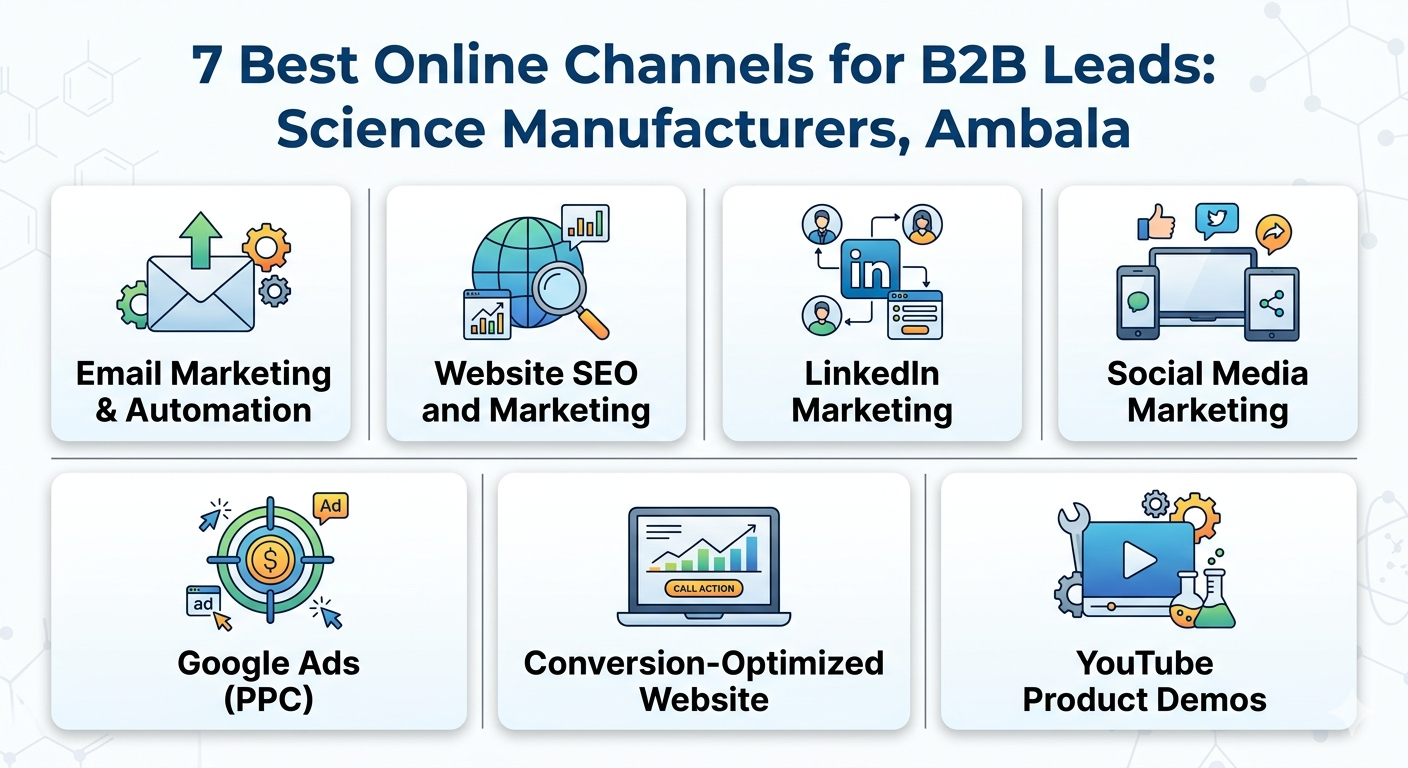
7 Best Online Channels for B2B Leads: Science Manufacturers, Ambala
Let’s get through the 7 best online channels that you can use to find B2B leads to sell your science instruments from Ambala to anywhere in the world.
1. Email Marketing & Automation
Yeah, email still converts. But not the way you think.
The trap: Most manufacturers blast old lists with lazy emails and hope volume fixes poor targeting.
What actually works:
- Segment by buyer type (schools vs. research labs vs. corporate testing)
- Automation sequences that feel like conversations, not templates
- Deliver real value between pitches (case studies, guides, how-tos)
- 8-12% response rates instead of the standard 2-3%
The move: Schools buying school lab equipment in Ambala have different needs than research institutions. Same microscope supplies, different pitch. Automation sequences reach out → deliver value → convert.
2. Website SEO and Marketing
Here’s the thing nobody wants to hear: if you don’t rank on Google for “chemistry lab equipment suppliers,” you’re already losing.
Why it matters: Procurement officers search Google. Not LinkedIn. Not trade magazines.
The mistake: Build a basic website → throw up photos → wonder why no inbound → give up.
What actually works:
- Start local: “Laboratory equipment suppliers Ambala,” “physics lab equipment manufacturers.”
- Move to service keywords: “Affordable spectrometer manufacturers in Punjab.”
- Create content that converts: “How to Set Up a School Lab on a Budget.”
- Compound over time: Month 1 = 2 visits. Month 6 = 30-40 monthly leads.
The edge: Most manufacturers aren’t doing SEO. Low competition. High intent searches. Ranking is easier than you think.
3. LinkedIn Marketing
LinkedIn is where decisions get made. It’s also where most manufacturers are invisible.
The opportunity: Procurement managers, lab directors, school administrators—all on LinkedIn. Not in your email inbox. Not at trade shows yet.
What moves needles:
- The founder/leader needs to be visible and consistent
- Share real stories, not sales pitches
- “We installed 50 microscopes in Delhi schools. Here’s what we learned.” → People engage. They DM. They remember you.
- Post 2-3x weekly. Build credibility. Become the go-to name.
The secondary play: Use LinkedIn to research accounts before you cold email them.
- Who’s hiring for lab management?
- Who’s posting about expansion?
- These are buyers. You’re no longer cold.
The result: When they need spectrometer manufacturers or chemistry lab equipment, your name comes up naturally.
Consistency + credibility = B2B leads on autopilot.
4. Social Media Marketing
Most manufacturers ignore this. That’s your edge.
The play: Short product videos on Instagram, TikTok, and YouTube Shorts.
- 15-second demo of your autoclave working.
- Time-lapse of setting up a school lab.
- Behind-the-scenes manufacturing footage.
- How-to guides on using microscopes or spectrometers.
Why it works:
- You’re reaching younger decision-makers and educators.
- They become your salespeople when they share your content.
- The algorithm favors video. Post 2-3x weekly.
- Your audience (teachers, students, lab techs) influences procurement decisions.
The result: Procurement people hear about you through their teams, not cold emails.
Your competitors think social doesn’t work for B2B manufacturing. They’re wrong. That’s your opening.
5. Google Ads (PPC)
This one is tactical and immediate.
What it does: Quick lead flow while you’re building organic channels.
Target keywords:
- “Spectrometer manufacturers in Ambala”
- “School lab equipment manufacturers”
- “Laboratory equipment suppliers near me”
The math:
- Low cost per click (small search volume, low competition).
- 5-10 qualified leads/week for $500-800/month spend.
- That’s real money in the short term.
The trap: Send traffic to homepage → no clear CTA → no conversions → blame Google Ads.
What actually works:
- Dedicated landing pages
- Clear value prop
- Customer testimonials
- Simple form or phone number
The strategy: Use Google Ads to fund the pipeline while SEO grows. Once organic kicks in, dial back paid ads. Leads keep coming without the spend.
6. Conversion-Optimized Website
You can drive all the traffic in the world. If your website converts at 1%, you’re losing money.
The problem: Most manufacturer websites are brochures. Pretty pictures. No journey. Visitor lands → doesn’t understand why → leaves.
What actually converts:
- Separate landing pages by buyer type (schools vs. research labs vs. corporate testing).
- Answer questions immediately: What? Who? Why better? Cost? How to buy?
- Case studies with real results (schools got labs set up in 2 weeks).
- Testimonials from respected institutions.
- Clear contact info and multiple ways to buy.
- Product specs that matter to engineers and procurement.
Don’t forget: Add a blog.
- “How to Choose the Right Spectrometer”
- “How to Maintain Laboratory Glassware”
- “How Much Does a Physics Lab Setup Cost?”
- These articles bring organic traffic and convert readers into leads.
Bottom line: Your website is the foundation. Every other channel feeds into it.
7. YouTube Product Demos
Here’s what’s working right now: long-form product content on YouTube.
What converts:
- 5-minute demo of your autoclave in action
- 10-minute walkthrough of microscope setup
- Tutorial on calibrating spectrometers
- Real applications. Real use cases. Real products.
Why it matters:
- YouTube is the second-largest search engine
- Decision-makers watch demos before buying
- They want to see if it actually works
- Your spec sheet won’t compete with a video
How to do it:
- Upload 2-3 videos/month
- Use your actual equipment
- Keep it simple and focused
- Consistency beats production quality
The ripple effect:
- Someone watches your 7-min demo → impressed → searches for you → finds your website → reaches out
- You didn’t chase them. They came to you.
- Videos on your website = longer time on site = better Google rankings
- Your SEO improves passively
The truth: Most competitors won’t bother. One more edge for you.
3 Practical Ways to Execute Every Lead Channel
Guess what? You can access all the lead channels with the help of 3 best ways. Let’s get some insights on how you can use them.
1. Digital Growth Ecosystem
The manufacturers are winning right now, especially scientific instrument manufacturers in Ambala, who aren’t executing each channel separately. They’re using one platform that connects them all.
How it works: Write one blog article. The system automatically:
- Posts to LinkedIn
- Schedules on Instagram
- Adds to email nurture
- Optimizes for SEO
- Tracks which channel drove leads
Time impact:
- Using digital growth ecosystem: 8 hours/week managing all 7 channels
- Managing tools separately: 20+ hours/week on coordination + switching
- That’s 2 FTEs worth of time saved
A small team running scientific instrument manufacturers in Ambala can’t afford 5 marketing people.
One person + ecosystem = full execution.
2. Digital Marketing Providers
The fastest-growing manufacturers aren’t hiring in-house marketers. They’re outsourcing to providers who specialize in B2B manufacturing.
What they bring:
- Dedicated team executes all 7 channels
- They know how manufacturers generate B2B leads
- They’ve done this 50+ times, not once
- You focus on product and sales
They understand:
- Which keywords actually convert for spectrometer manufacturers
- Email sequences for procurement officers
- What YouTube demo content works
- Technical buyer landing page optimization
Avoid: Digital marketing agencies that want to own everything. Good ones work within your systems.
3. Database Providers
The cheapest way to execute all channels is to pick the right database, then build automation around it.
What this means:
- One clean database of qualified prospects
- Feed into the email tool
- Email creates LinkedIn sequences
- Track conversions
- Feed data back for smarter segmentation
How it flows: Buy a database of scientific instrument manufacturers in Ambala matching your profile.
Then:
- Email pulls from the database and sends sequences
- LinkedIn uses the same list for connections + DMs
- Google Ads builds lookalike audiences from a database
- Conversion data goes back to improve segmentation
Why this works: One good database > five bad lists.
Every channel talks to the same audience. You see patterns. Someone ignores email but engages on LinkedIn? Move them to Google Ads. Does someone open every email? Prioritize personal outreach.
Pro tip: Start with database + email. Get that working. Layer in LinkedIn automation. Then Google Ads. Don’t do everything at once.
What is the Future of Scientific Instrument Manufacturers If They Go Digital?
The most important thing for the scientific instrument manufacturers is what the future will be like if they apply digital growth ecosystem services.
1. Smart & Connected Instruments
The biggest shift is obvious: instruments are no longer expected to stay isolated.
Buyers now expect equipment that can connect with software dashboards, cloud systems, and internal lab workflows. A microscope, testing unit, or measurement device that only performs a function without sharing data starts to feel outdated.
The companies that move first here create stickier products.
For scientific instrument manufacturers in Ambala, this is where traditional manufacturing starts turning into a long-term product ecosystem.
2. As-a-Service (XaaS) Models
The future of scientific instrument manufacturers may not be about one-time product sales at all. More players will move toward service-led revenue.
Think subscription-based calibration, maintenance packages, remote diagnostics, usage-based billing, or even equipment leasing.
Instead of selling one machine every few years, businesses can create predictable recurring revenue. From an operator’s lens, this changes cash flow quality.
From an investor’s lens, recurring revenue almost always looks stronger than one-time transactional sales. That alone can redefine how these businesses are valued.
3. Enhanced Customer Collaboration
One thing industrial businesses often underestimate is how many buying decisions now happen before the first call. Customers want faster collaboration.
They want product catalogs, technical documentation, live demos, RFQ workflows, and support channels available digitally.
The future is less about “sales follow-up” and more about frictionless decision-making.
When a lab, institution, or distributor can compare specs, request customizations, and get answers faster, conversion cycles shorten. That means faster pipeline movement and better lead quality.
4. Data Management & Security
Once products go digital, data becomes part of the product. And that changes responsibility.
Instrument usage data, research logs, calibration history, and operational metrics all become valuable assets. The companies that manage this well will build trust. The ones that ignore security will lose it quickly.
In sectors like healthcare, education, and industrial testing, secure data workflows are not optional anymore. Good data systems improve compliance, service quality, and customer confidence.
5. Modular Automation
The future is likely modular, not monolithic. Instead of fully replacing existing systems, the smarter move is modular automation.
Small workflow automations. Inventory sync. Maintenance alerts. Auto-report generation. CRM-linked inquiry systems.
The businesses that layer automation gradually tend to scale better because teams actually adopt it.
This matters for founders because digital transformation fails when it is too big, too fast, and too disconnected from operations. The best manufacturers will automate the bottlenecks first.
Explore More with GrowNerds
In the end, this isn’t just about getting more leads. It’s about being visible when the right buyers start looking. The brands that win are the ones that show up early, build trust fast, and stay top of mind through the decision journey. That’s exactly how scientific instrument manufacturers can generate B2B leads online in today’s market.
At Grownerds, we help make that shift practical. Better visibility. Better-quality inquiries. Faster decision cycles. Smarter digital systems that actually support growth. Start your journey with a clear path from online presence to real business outcomes.
If you’re thinking about where your next serious buyer will find you, this might be the right time to start that conversation below.
FAQs
1) How can scientific instrument manufacturers generate B2B leads online?
Scientific instrument manufacturers can generate B2B leads online by building visibility across the channels where buyers already research solutions. This includes SEO-driven websites, Google Ads, LinkedIn marketing, email automation, product demo videos, and conversion-focused landing pages. The goal is to reach procurement teams, lab directors, schools, and research institutions before they contact competitors.
2) Why is traditional lead generation no longer enough?
Traditional methods like cold emails, static lead lists, and distributor-only selling are no longer enough because buyers now complete a major part of their research journey online. By the time they speak to a sales team, they have often already compared vendors, watched demos, and read reviews. That is why digital presence has become essential for lead generation.
3) Which online channel works best for scientific instrument manufacturers?
There is no single channel that works alone. A strong mix usually delivers the best results. SEO helps long-term visibility, Google Ads brings immediate inquiries, LinkedIn builds trust, and YouTube demos improve product confidence. The most effective strategy is an ecosystem where all channels work together.
4) How important is SEO for scientific instrument manufacturers?
SEO is one of the most important channels because buyers actively search on Google for suppliers, product categories, and local manufacturers. Ranking for terms like laboratory equipment suppliers, spectrometer manufacturers, or chemistry lab equipment helps capture high-intent traffic from decision-makers who are already looking to buy.
5) Does LinkedIn help generate B2B leads in this industry?
Yes, LinkedIn is highly effective for B2B lead generation in the scientific instrument industry. Procurement heads, lab managers, school administrators, and corporate buyers are active on the platform. Consistent founder-led posting, real case studies, and industry insights help build credibility and attract qualified inquiries.
6) How can a website improve lead conversions?
A website improves lead conversions when it is built for decision-making, not just presentation. This includes separate landing pages for different buyer types, clear product specifications, testimonials, case studies, and easy inquiry forms. A conversion-optimized website turns traffic from SEO, ads, and social media into real leads.
7) What is the future of scientific instrument manufacturers in digital growth?
The future is digital-first. Buyers now expect smart connected instruments, digital collaboration, cloud-based workflows, recurring service models, and faster online support systems. Manufacturers that adopt digital ecosystems early are more likely to build stronger pipelines and recurring revenue opportunities.
8) How can Grownerds help scientific instrument manufacturers grow online?
Grownerds helps scientific instrument manufacturers build a connected digital growth ecosystem through SEO, content strategy, lead generation channels, conversion-focused websites, and visibility systems that turn online traffic into qualified business opportunities.
Digital growth strategist helping businesses build their online presence through strategy, design, and marketing systems.
Leave a Reply