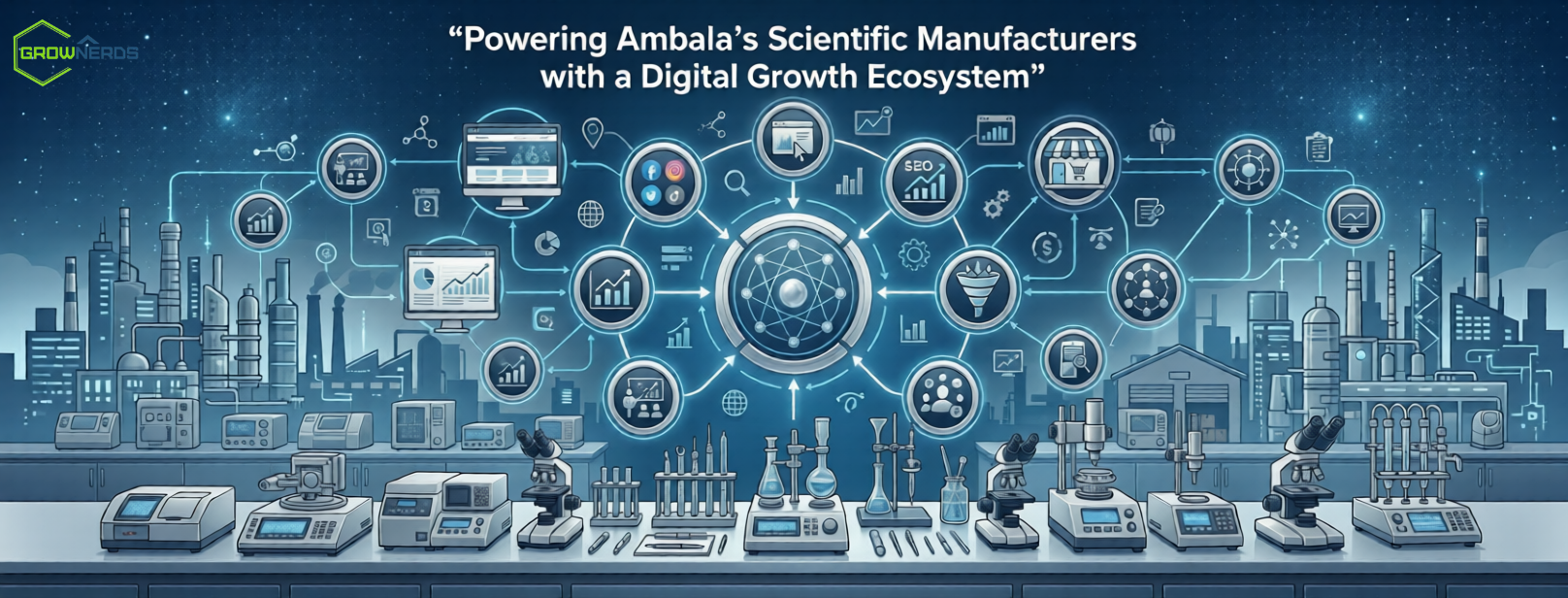
A factory in Ambala. Solid products. Decades of trust. Still running at 50% capacity. Not because demand is missing. Because demand can’t see them.
Scientific instrument manufacturers are relying on distributors, trade fairs, and referrals, while global buyers are already online, comparing, shortlisting, and closing without ever visiting a plant.
That’s the shift.
The few who’ve built a digital growth ecosystem for science manufacturers, sharp websites, tight CRM loops, and performance marketing for scientific instrument manufacturers aren’t waiting for orders anymore. They’re capturing them.
And when it clicks, it clicks fast.
20% adoption across Ambala’s SMEs can unlock ₹2,000 crore in just one year. Push it to 60%, and you’re staring at ₹8,000 crore within three. Higher capacity. Stronger exports. Predictable pipelines.
This isn’t about “going digital.” It’s about building a system where demand finds you and converts. Because the next wave of global manufacturing winners won’t just build better products. They’ll build better ecosystems around them.
Understanding Ambala’s Scientific Instrument Industry
Most people underestimate Ambala.
From the outside, it looks like just another Tier-2 cluster. But if you’ve spent time around scientific instrument manufacturers in Ambala, Haryana, you realize this is a deeply specialized ecosystem. Not flashy. Not loud. But quietly moving a serious volume is.
And that’s exactly why it’s interesting.
- This is a legacy industry trying to behave like a modern one
- Distribution is still stuck in the old world
- Product quality is not the bottleneck anymore
- Digital presence is there, but it’s mostly cosmetic
- The real opportunity is not software; it’s systems
- This is a cluster waiting for aggregation
From start to end, the player who builds a strong digital ecosystem around scientific instrument manufacturers in Ambala, Haryana, doesn’t just sell services: they shape the market narrative.
3 Key Challenges Manufacturers Face Today
Manufacturing today is no longer limited by production capacity alone; visibility, access, and trust now define growth.
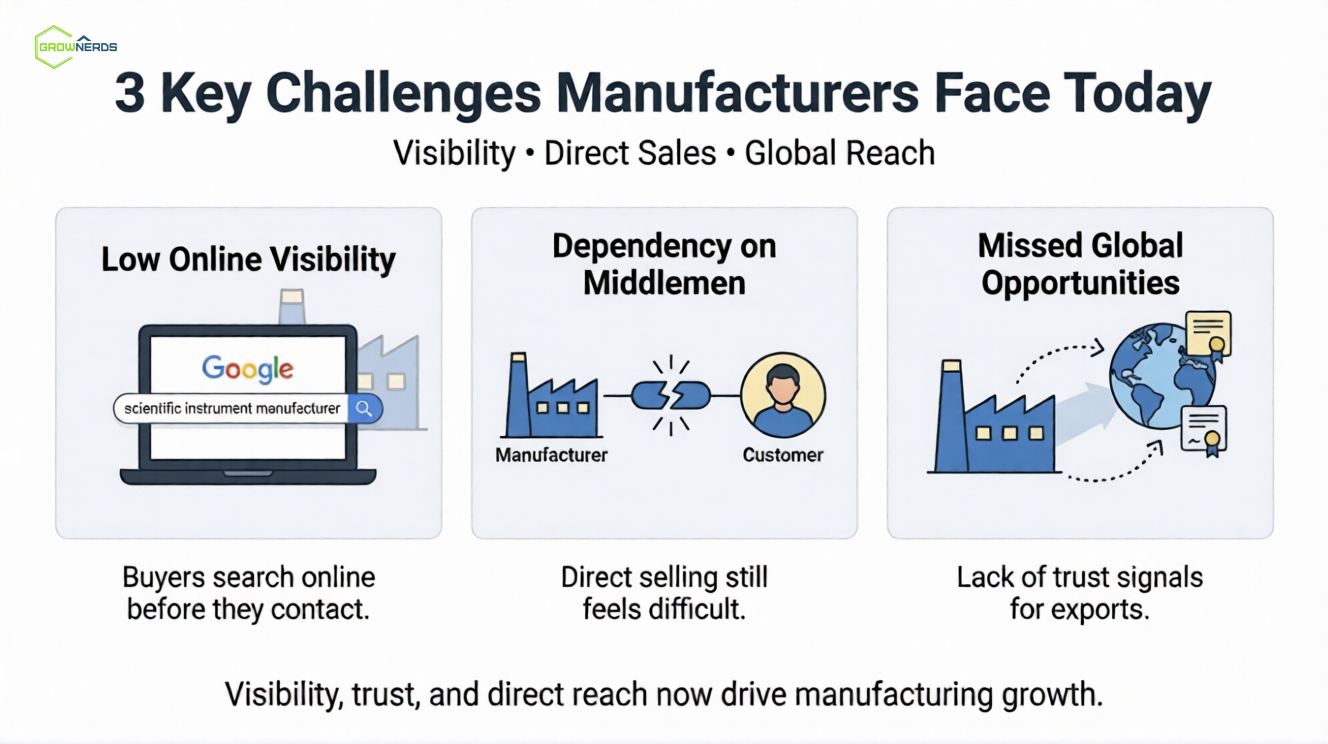
1. Buyers Search on Google Before Contacting
Most manufacturers still think the first touchpoint is a call or a dealer. It’s not. It’s a search.
Buyers are typing product specs, comparing vendors, and checking credibility, all before they reach out. If you don’t show up there, you’re invisible.
Why it matters: You lose deals without even knowing they existed. The demand is there. You’re just not part of the consideration set.
2. Direct Customer Acquisition (No Middlemen)
Manufacturers want to sell directly. Better margins, more control, cleaner feedback loops. But most don’t know how to actually pull it off.
They’re still wired to depend on distributors.
Business impact: You stay stuck sharing margins and customer relationships. Without a proper digital growth ecosystem for manufacturers, going direct feels risky, so it never happens.
3. Export Opportunities
Everyone talks about exports. Few are actually set up for it.
Not because of product issues. But because global buyers expect clarity: catalogues, certifications, positioning, and trust signals.
Most manufacturers aren’t packaging themselves for that audience.
Why it matters: You end up competing locally when you could be pricing globally. The upside is massive, but only if you’re discoverable and credible beyond your existing network.
What is a Digital Growth Ecosystem?
Most companies think growth is about doing more marketing. It’s not. It’s about making everything work together.
Manufacturers who invest in websites and run ads on LinkedIn still struggle to generate consistent demand.
Not because the pieces are wrong. Because they’re disconnected.
A digital growth ecosystem is simply that shift. From scattered efforts → to a system that compounds.
Here are the core components you should build and connect into a single system.
Core Components
1. Website (foundation)
Most industrial websites look decent. But they don’t move the buyer forward. Your site isn’t a brochure anymore. It’s where first impressions turn into intent.
If it doesn’t answer questions fast or build trust, you lose deals before conversations even start. For anyone serious about digital solutions for science manufacturing companies, this is ground zero.
2. SEO (Visibility)
If you’re not showing up when buyers search, you don’t exist. It’s that simple. SEO isn’t about traffic volume. It’s about being present at the exact moment of need.
Especially in niche industrial markets, a few high-intent keywords can drive serious revenue. This is where the long-term pipeline starts building quietly.
3. Content (Authority)
Most founders underestimate how much buyers research. They come prepared now.
Content is what shapes that research. It answers, compares, and explains before your sales team even joins. In places pushing industrial digital transformation Ambala, this becomes even more critical.
Because trust isn’t built in one call. It’s built over multiple touchpoints. For that you can choose a right Digital ,arket
4. Social Media (Trust)
Ignoring social media today is risky. Not because it drives direct leads but because it builds perception.
Buyers check you out. Quietly. They look at your activity, your thinking, and your consistency. If you’re invisible or inactive, it raises questions.
For industrial brands, this is less about going viral, more about showing you’re real and relevant.
5. Paid ADs (Quick Demand)
Organic takes time. Sometimes you need leads now. That’s where paid ads come in. Fast visibility. Controlled experiments.
But here’s the catch: ads only work if the rest of the system is solid. Otherwise, you’re just paying to expose weak positioning.
Used right, this becomes a lever. Used incorrectly, it burns cash.
6. CRM/automation (Conversion & Retention)
Most companies lose leads after they generate them. That’s the hidden leak. No follow-ups, no tracking, no structure.
A basic CRM fixes that. Automation strengthens it. Now leads don’t slip. Conversations don’t go cold. And repeat business becomes easier. This is what turns activity into actual revenue.
5 Key Elements of a Digital Growth Ecosystem
These five elements are what transform a manufacturer’s digital presence from static to revenue-generating.
1. High-Performance Website
Most manufacturer websites are just digital brochures. They look fine. But they don’t sell.
A high-performance site is built to convert: clear positioning, product clarity, fast loads, and strong trust signals. It’s your first salesperson, working 24/7.
Business impact: Better first impressions. Higher conversion from inbound. Less dependency on offline meetings.
2. SEO for Scientific Instrument Manufacturers
If you’re not ranking, you’re not in the game.
Buyers search specific terms: product names, use cases, and comparisons. And they usually don’t go past page one.
This is where a real digital growth ecosystem for manufacturers starts to show up consistently, not randomly.
Why it matters: Organic visibility compounds. You start getting inbound without chasing. And those leads? Warmer, cheaper, easier to close.
3. Content Marketing
Most companies either ignore content or do it half-heartedly. But in this space, content is trust.
Catalogues, guides, application notes, and comparison pages: this is what global buyers actually read before making a decision.
Business impact: You move from “just another supplier” to “the one who knows their stuff.” That shift alone improves pricing power.
4. LinkedIn & B2B Social Presence
While everyone’s stuck at trade fairs, decision-makers are scrolling LinkedIn. Quietly evaluating vendors.
A consistent presence (not spam, but real insights) builds familiarity over time. That’s how deals start before conversations happen.
Why companies should care: In a B2B digital ecosystem for manufacturers, visibility isn’t just search. It’s also social proof. And LinkedIn does that job well.
5. Lead Generation System
Leads don’t come from one channel anymore.
You need a system. Website + SEO + content + social — all feeding into a clear capture and follow-up flow.
Most manufacturers miss this. They generate interest but don’t capture or nurture it properly.
Business impact: Leads stop leaking. Sales cycles shorten. And suddenly, growth feels predictable.
How Does GrowNerds Build a Complete Digital Growth Ecosystem for Manufacturers?
This is the exact framework GrowNerds uses to help manufacturers transform fragmented marketing into a scalable digital growth engine.
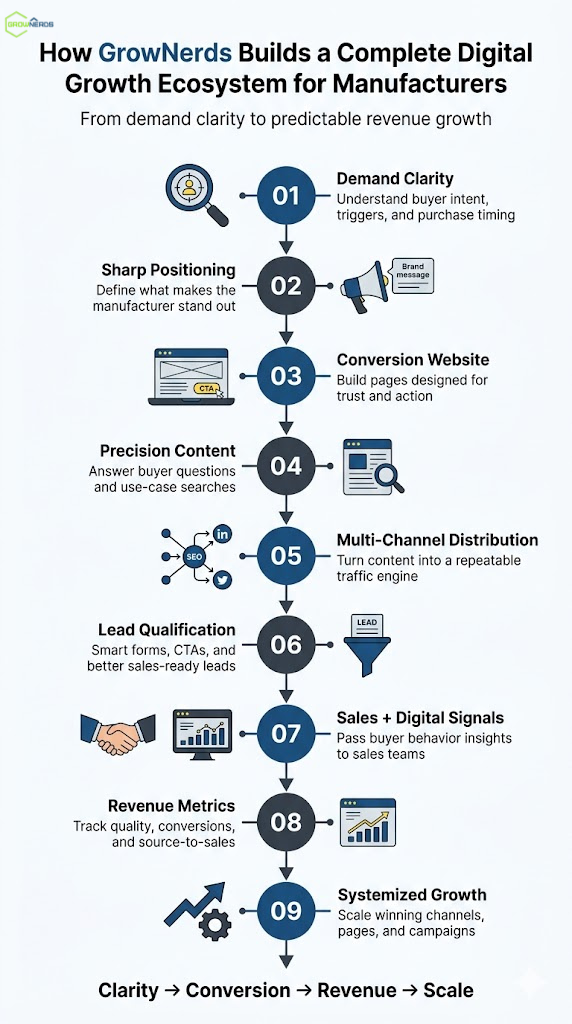
Step 1: Start with demand clarity, not marketing
Most industrial companies jump straight into execution. Website. Ads. SEO. That is a totally wrong starting point.
First, you figure out:
- Who is actually buying?
- Why now?
- What triggers the purchase?
Without this, everything else becomes noise.
This step shapes your entire digital growth ecosystem for science manufacturers.
Step 2: Fix positioning before traffic
If your message is weak, more traffic won’t help. It’ll just waste money faster. You need sharp positioning:
- What do you do better?
- Who is it for?
- Why should anyone care?
For industrial companies, clarity beats creativity. This is where most “marketing” fails. Because no one stops to fix the story first.
Step 3: Build a website that actually sells
Most manufacturing websites look fine. But they don’t convert. The shift is simple: Stop designing for looks. Start designing for decisions.
Every page should answer:
- What is this?
- Is it for me?
- Can I trust this company?
- What do I do next?
This is the foundation of full-stack digital growth for science manufacturing in Ambala. Your site becomes the central conversion layer.
Step 4: Create high-intent content, not random blogs
Content isn’t about volume. It’s about precision. You should focus on:
- Buyer questions
- Comparisons
- Use cases
- Industry-specific problems
This is what actually brings qualified traffic.
For most industrial players, this becomes one of the best digital marketing strategies for industrial companies in Ambala.
Because instead of chasing leads, you let them find you with context.
Step 5: Build distribution loops early
Publishing alone won’t move the needle. Distribution does. You connect:
- SEO
- LinkedIn (or industry platforms)
- Direct outreach
- Marketplaces/directories
Each piece of content gets reused across channels. Now, traffic isn’t dependent on one source. It becomes a system.
Step 6: Capture and Qualify leads properly
Traffic without capture is wasted effort. Most companies either
- Ask too little (low-quality leads)
- Or too much (no leads)
You need balance.
Smart forms. Clear CTAs. And basic qualifications are baked in. This reduces noise for the sales team. And improves close rates without extra effort.
Step 7: Align Sales with Digital Signals
Marketing and sales usually operate in silos. That slows everything down. Instead, you pass context:
- Which page they visited
- What content did they consume
- What problem are they likely solving
Now sales conversations start warmer. Shorter cycles, better conversions. This is where the digital growth ecosystem starts feeling real.
Step 8: Track What Actually Drives Revenue
Vanity metrics are dangerous: traffic, impressions, and likes. They don’t pay the bills.
You must track:
- Lead quality
- Conversion rates
- Deal velocity
- Source-to-revenue mapping
Now you know what’s working. And what’s just activity?
Step 9: Double Down and Systemize
Once you see patterns, you scale them.
- Winning pages → more like them
- High-performing channels → more budget
- Strong messages → repeat across campaigns
This is where growth becomes predictable.
How Does a Digital Ecosystem Drive Real Growth?
Growth stops being random when your digital presence starts working like a system, not a set of disconnected efforts.
✔ More Inbound Leads
Most manufacturers are chasing leads. Cold calls, exhibitions, and references. It’s all outbound-heavy.
A solid digital growth ecosystem for science manufacturers flips that. You start getting discovered instead of doing all the chasing.
✔ Better Quality Inquiries
Not all leads are equal. When someone finds you through search or content, they’ve already done homework. They know what they want. They’ve shortlisted you for a reason.
✔ Reduced Dependency on Agents
Most manufacturers don’t like admitting this. They’re heavily dependent on dealers and agents. Not just for sales, but for market access. A working digital system gives you a direct line to customers.
✔ Stronger Brand Recall
In B2B, people don’t buy instantly. They’ve seen you a few times. Website, LinkedIn, maybe a blog. Then they remember. That consistency is what builds recall.
✔ Scalable Growth
Most offline growth hits a ceiling. You can only attend so many exhibitions. Your sales team can only handle so many meetings. Digital doesn’t have that limit.
Once the system is in place, it scales. More traffic, more leads, more reach, without linear cost increase.
From Local to Global: Expanding Beyond Ambala
For Ambala’s manufacturers, the real growth opportunity begins beyond city borders.
★ Export Potential
Most manufacturers in Ambala are sitting on export-ready products. They just don’t position them that way.
Quality is there. Pricing is competitive. But the mindset is still local-first. That’s where the gap starts.
Why it matters: You end up fighting for smaller deals locally while global markets are willing to pay more for the same product.
★ Reaching international buyers
Global buyers aren’t walking into your factory. They’re searching. Comparing. Shortlisting online.
If your presence isn’t built for them, you don’t exist in their world. This is where a complete digital ecosystem for science manufacturers actually becomes a growth lever, not just a nice-to-have.
Business impact: Visibility drives access. Access drives deals. No visibility, no international pipeline.
★ Competing with global brands
You’re not just competing with local players anymore. You’re competing with polished global brands that know how to present themselves.
- Better websites.
- Better catalogs.
- Better storytelling.
Why companies should care: Even if your product is comparable, perception decides who wins. Strong digital marketing for the scientific instrument industry closes that gap faster than anything else.
★ Digital = Borderless Growth
Geography matters less than people think. Distribution used to be physical. Now it’s digital.
A strong online growth strategy for manufacturers means your reach isn’t limited to Ambala or even India. It’s wherever your buyer is searching from.
Business impact: You unlock scale without opening new offices. More markets, same infrastructure. That’s leverage.
3 Reasons Why Most Manufacturers Fail at Digital
Most manufacturers don’t fail at digital because the market isn’t ready. They fail because the approach is fundamentally broken from day one.
1. Treating it as a One-time Project
Most manufacturers approach digital like a factory setup. Build the website. Upload products. Done. But digital doesn’t work like machinery. It’s not an install-and-forget thing. It needs iteration, updates, and constant tuning.
Business impact: You launch… and then nothing happens. No traffic. No leads. And slowly, you conclude, “Digital doesn’t work.”
2. Hiring freelancers instead of systems
One freelancer for a website. Another for SEO. Someone else for social media. No one is actually owns outcomes.
You don’t get a system. You get scattered activity.
Why it matters: Everything looks busy, but nothing compounds: no clear funnel, no consistency, no measurable growth.
3. No long-term strategy
Most efforts are reactive.
“Let’s try SEO, or let’s post on LinkedIn, or let’s run ads for a month.”
There’s no clear direction tying it all together.
Business impact: You burn time and money without building momentum. Digital only works when it stacks over time, not when it resets every few months.
Ending Words
Manufacturing in Ambala has never lacked capability; what’s been missing is a system that turns capability into visible, scalable demand. A well-built digital growth ecosystem for science manufacturers changes that by bringing together visibility, trust, lead flow, and long-term momentum.
That’s where GrowNerds comes in: with sharp positioning, conversion-focused digital systems, market-specific expertise, measurable revenue impact, and a growth approach built for scale, not vanity.
We don’t just help manufacturers “go digital”; we help them become discoverable, credible, and globally competitive. If you’re ready to turn capacity into consistent demand, the next conversation could be the one that changes your growth trajectory.
Faqs
How can we get more qualified buyers online?
Buyers finish 67% of their research before calling you. Win them before that call. Build product pages around how they search (“CBSE lab equipment supplier India”). Run LinkedIn ads targeting school principals and lab procurement heads. Pick 50 ideal accounts: colleges, hospital labs, and pharma units, and go deep on those instead of chasing volume.
What’s the ROI: how soon will we see more orders?
- Month 1–3: First inquiries from Google Ads + GeM listing.
- Month 3–6: SEO and LinkedIn build a real pipeline.
- Month 6–12: Tenders won, dealers activated, repeat orders start.
Digitally active manufacturers see 30% lower acquisition costs and 35% higher conversion. The investment compounds—year 2 is far cheaper than year 1.
Which digital channels work best for educational & lab equipment?
Google Ads: captures buyers searching right now.
LinkedIn: target by job title: lab director, procurement officer, and principal. Best quality leads (14–18% conversion).
GeM Portal: direct access to government tenders. Only 3–8 bidders per scientific instrument tender on average.
YouTube demo videos: 3-minute product demos outperform any brochure.
How can we stand out from competitors in Ambala and China?
China has taken ~45% of Ambala’s market on price and finish. You cannot win on price; win on proof. Show ISO certs, BIS marks, calibration reports, and past DRDO/government supply history on every page.
Add a comparison page: “Indian-made vs. imported accuracy, warranty, service response.” Chinese sellers cannot offer local AMC visits or Hindi-language support. Make that your headline.
Can we still sell to dealers, distributors, and government tenders digitally?
Yes, digital makes these channels bigger. GeM covers ₹50–70 lakh crore in annual government procurement. MSME registration gives you EMD exemption, 15% price preference even if not the lowest bidder, and 25% reservation in tenders.
For dealers, a simple B2B portal (separate login, wholesale pricing, order tracking) lets them order at 2 AM — no phone calls needed. Use LinkedIn to find new distributors in states where you have zero presence.
How do we handle long sales cycles and technical queries online?
Digital keeps you top-of-mind without burning sales rep time. Set up a free HubSpot CRM and a 6-email nurture sequence over 90 days. “How to choose the right microscope,” “questions to ask before buying,” and “Why Indian Instruments Outperform Imports.”
A chatbot on product pages answers spec questions 24/7 and books demos automatically. Manufacturers using this see 157% faster speed-to-lead.
Is our team ready to manage this, or will it become extra work?
It adds work initially, then automation reduces it. Start small: one person, 4 hours/week on website + GeM + CRM. Month 3, outsource Google Ads to a local agency for ₹15,000–20,000/month.
Month 6, email automation runs follow-ups without human effort. By month 9, the system qualifies and nurtures leads on its own — your team only handles warm conversations. Most Ambala competitors aren’t doing any of this. First mover wins.
Digital growth strategist helping businesses build their online presence through strategy, design, and marketing systems.
Leave a Reply